Jurassic Dinos editorial · Updated · Source-based review
What was Mahakala?
Mahakala omnogovae was a small dromaeosaurid dinosaur from Late Cretaceous Mongolia. The description published in 2007 made it important to a question larger than its own body: when did very small size appear among dinosaurs close to the ancestry of birds?
Why did a small dinosaur matter?
The original analysis placed Mahakala on an early branch within Dromaeosauridae. Combining its position with its small body size, the authors inferred that substantial miniaturisation had occurred near the ancestry of paravians. Paraves includes birds and closely related dinosaur groups, including dromaeosaurids and troodontids.
Their interpretation placed small size earlier in that evolutionary history than the point where flight was strongly inferred. That does not mean that every small paravian flew. Body size is one part of the problem; the structures and performance needed for flight require additional evidence. A lightweight-looking illustration cannot supply those tests by itself.
Does early-branching mean geologically oldest?
No. An animal can preserve a combination of features associated with an early split while living much later than the split itself. Mahakala’s Late Cretaceous age therefore does not conflict with its position on an early dromaeosaurid branch in the 2007 analysis.
It is helpful to imagine two separate labels beside a fossil: the date of the rocks and the proposed position in an evolutionary tree. Neither label can simply replace the other. Likewise, an early-branching relative is not automatically the direct ancestor of a later or more familiar species.
Did dinosaur bodies only become smaller toward birds?
The study argued against a one-way shrinking story. Larger sizes evolved independently in some bird-related dinosaur lineages. Evolutionary history can include both increases and decreases, rather than a universal march toward one final size. Mahakala helped make that pattern visible in an analysis of several groups.
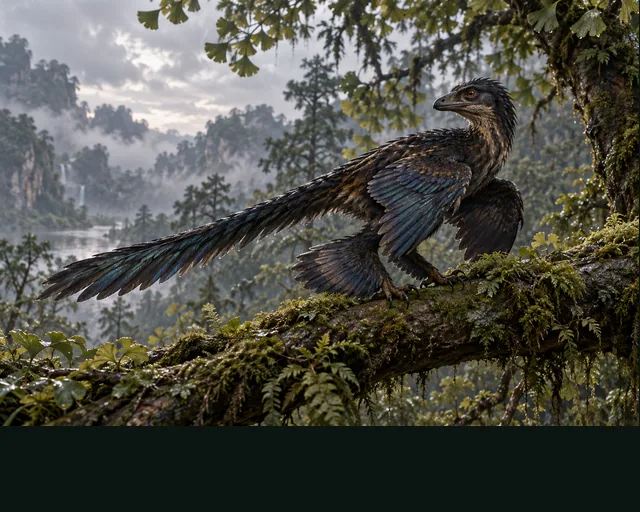
Our image follows the approved named complete restoration, with short folded forelimbs and a very long narrow tail. Its precise feathers, markings and dry landscape are artistic choices, not direct evidence of flight or a particular diet. Compare Velociraptor and Microraptor as separate accounts, then explore the M directory.
Quick answers
- Where was Mahakala found?
- Mongolia.
- Was it a dromaeosaurid?
- Yes. The original analysis placed it on an early branch of that group.
- Does early-branching mean it lived before every relative?
- No. Branching position and geological age are different.
- Does a small feathered reconstruction demonstrate flight?
- No. Small size alone does not establish flight ability.