Jurassic Dinos editorial · Updated · Source-based review
What was Lythronax?
Lythronax was a tyrannosaurid from Late Cretaceous Utah. A partial skull and skeleton reveal a powerful predator whose broad rear skull and forward-facing eyes invite comparison with Tyrannosaurus. It lived earlier, however, and is valuable for investigating how the characteristic tyrannosaurid head developed.
What makes the fossil distinctive?
The skull is more informative than a simple label such as “smaller T. rex.” Its rear region is broad, while details of the upper jaw and tooth arrangement distinguish it from other members of the family. Forward-facing eyes suggest overlapping fields of view, but an eye socket does not preserve an animal’s exact visual abilities. Missing parts of a mount must be reconstructed using comparisons, rather than treated as bones recovered from this individual.
Where was it found and how was it named?
The specimen was found in the Wahweap Formation in 2009 and described as Lythronax argestes in 2013. The rocks place it in the Campanian portion of the Late Cretaceous. At that time western North America formed a landmass often called Laramidia, separated from the east by an inland seaway. This geographical setting helps researchers investigate the distribution of tyrannosaurids.
What can we infer, and what remains uncertain?
Published reconstructions give different overall size estimates because the skeleton is incomplete and the proportions used in calculations can differ. An estimated length is not a tape-measure reading from a whole animal. The name is often translated as “gore king,” but names are chosen by people and do not establish which prey was eaten or how a hunt unfolded. Its strongest teaching value is the combination of an older age with familiar-looking tyrannosaurid skull features.
Was Lythronax the direct ancestor of T. rex?
Its earlier age does not prove direct ancestry. It was a relative that helps document tyrannosaurid evolution; a family tree can contain many side branches.
How can you check the evidence?
The Paleobiology Database record catalogues Lythronax under Tyrannosaurinae. Its linked bibliography identifies this research starting point: M. A. Loewen, R. B. Irmis, and J. J. W. Sertich, P. J. Currie, S. D. Sampson. 2013. Tyrant dinosaur evolution tracks the rise and fall of Late Cretaceous oceans. PLoS ONE 8(11):e79420. Open the bibliographic record. A catalogue entry establishes the source trail; it does not independently verify every later illustration or behavioural claim.
Use the dated genus overview to follow the references behind the discovery and anatomy discussed above. When sources disagree, compare which specimen and rock layer each author studied. A reconstructed whole animal can combine original bones with comparisons to relatives; those two kinds of evidence should not be confused. The account above explains the particular limits that matter for Lythronax, rather than supplying unsupported size, speed or lifespan figures.
Read the image and keep exploring
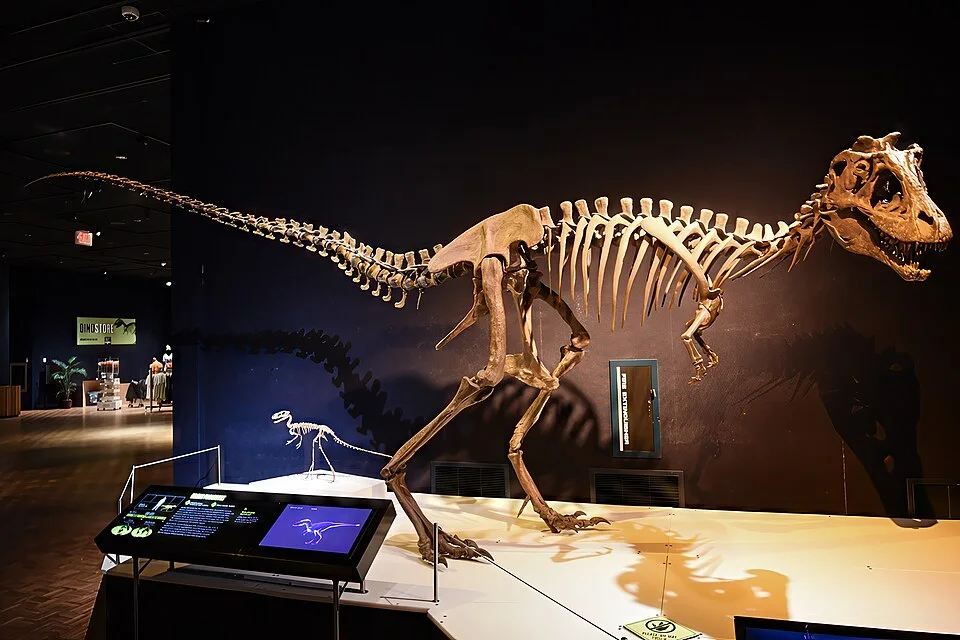
A Lythronax skeletal mount illustrates the reconstructed tyrannosaur body; not every displayed element represents an original fossil. A displayed specimen or skeletal mount can include restored parts. Its appearance should be read alongside the original specimen description.
Compare Tyrannosaurus, Tarbosaurus, Albertosaurus. Find more names in the L index and explore theropod field notes. The glossary explains unfamiliar fossil terms.
Quick answers
- Where have Lythronax fossils been found?
- The discoveries discussed here come from United States. Modern place names describe discovery locations, not a complete ancient geographic range.
- When did Lythronax live?
- It is placed in the Cretaceous period. See the discovery discussion for qualifications about the particular rock layers and dating.
- Where can I compare Lythronax with related dinosaurs?
- Follow the related field notes below. Comparisons explain shared anatomy; they do not imply that all the animals lived together.