Jurassic Dinos editorial · Updated · Source-based review
What was Linheraptor?
Linheraptor exquisitus was a dromaeosaurid theropod from Late Cretaceous Inner Mongolia, China. Dromaeosaurids are the dinosaur group that includes Velociraptor. The original description appeared in 2010, following the discovery of its unusually well-preserved specimen during a 2008 expedition at Bayan Mandahu.
Why was the discovery exceptional?
The type specimen, IVPP V16923, is a nearly complete articulated skeleton. Articulated means that many bones remain in their anatomical connections, instead of being scattered and mixed into a collection of isolated pieces. The species name exquisitus refers to this exceptional preservation.
That condition helps researchers compare features from different regions of the same animal. It reduces some uncertainty about whether a skull and limb bone actually belong together. However, nearly complete does not mean that every soft tissue survived, that original colours are known or that the animal’s entire behaviour can be read directly from the fossil.
What did researchers compare?
The describing team highlighted similarities with another Asian dromaeosaurid, Tsaagan. These included the position and size of a skull opening and contacts between particular skull bones. They used combinations of such details to suggest a close relationship, rather than relying only on a general raptor-like outline.
The paper also cautions that preservation can distort skull proportions. A flattened skull may look shallower than it did in life. This makes a useful scientific lesson: before treating a difference as evidence of a different species, researchers need to consider what happened during burial and fossilisation. Careful comparison includes checking the reliability of the apparent difference itself.
What belongs to the living reconstruction?
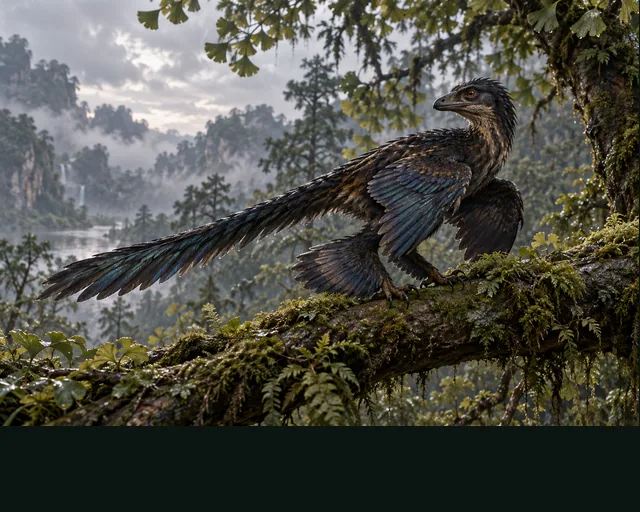
Our whole-animal image follows an approved, specifically named feathered Linheraptor restoration. Notice its low snout, feathered forearms, long tail and raised second-toe claws. The particular feather arrangement, colour pattern and head plume belong to the artistic reconstruction; the reviewed description does not establish those details from preserved feathers in the type specimen.
The new dry landscape is an illustrative setting, not a photograph of the excavation site. Visit Velociraptor and Microraptor for independently documented relatives, and explore the L directory. Compare which kinds of evidence support each animal’s anatomy and covering, rather than assuming that all feathered dinosaur pictures rest on identical fossil evidence.
Quick answers
- What does exquisitus refer to?
- The exceptional preservation of the type specimen.
- Where was Linheraptor found?
- Bayan Mandahu in Inner Mongolia, China.
- Was its type only an isolated tooth?
- No. It is a nearly complete articulated skeleton.
- Does skeletal completeness prove the pictured feather colours?
- No. Plumage details and colours remain restoration choices.