Jurassic Dinos editorial · Updated · Source-based review
What was Leshansaurus?
Leshansaurus qianweiensis was a meat-eating theropod dinosaur described from Qianwei County in Sichuan, China. The original 2009 study placed its fossil-bearing rocks in the upper part of the Shangshaximiao, or Upper Shaximiao, Formation and identified them as Late Jurassic. The genus name refers to Leshan; the species name points more specifically to Qianwei.
How did the discovery become a scientific name?
The original paper reports a discovery during ground works for a new house, followed by organised excavation by a team from the Zigong Dinosaur Museum. Finding a fossil is the beginning of the investigation. Researchers must also record its geological setting, prepare the material and compare preserved structures with previously described dinosaurs.
In this case, the comparisons included details of the skull, neck and trunk vertebrae, and pelvis. These are more informative for naming the animal than whether a reconstruction looks fierce. A useful distinction is between recognising a general predatory-dinosaur outline and identifying the particular combination of features associated with one genus.
Why can its proposed relatives change?
The describing authors suggested affinities with sinraptorids. The current exact-name database record reflects a different narrower placement. We therefore retain the broad, well-supported theropod identity here rather than treating the original family assignment as an unchanging fact. A skull opening, a ridge on a bone and the proportions of adjacent structures can each contribute evidence; one dramatic-looking feature is rarely the entire case.
Relationships are hypotheses tested with anatomical comparisons and different samples of animals. A later analysis can move a named dinosaur to another branch while the original fossil discovery and name remain important. That does not require repainting its skin to match the colours of a new supposed relative.
What does our illustration show?
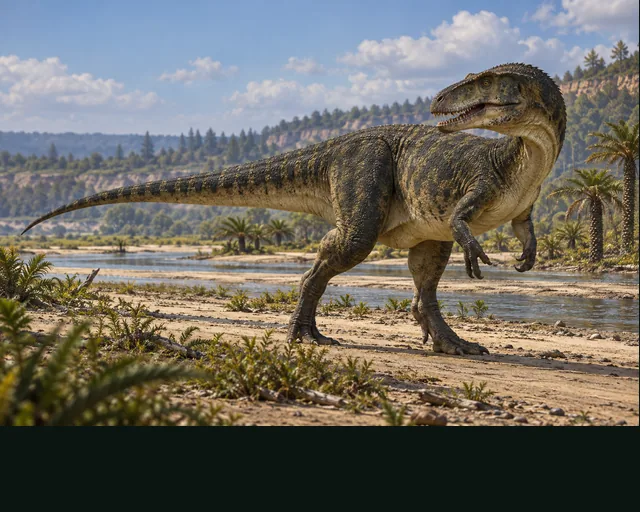
The approved complete living reference depicts an elongated head, short grasping arms, strong hindlegs and a long balancing tail. Our independently composed image follows that named restoration. Its warm skin colours, dark markings and forest lighting are artistic choices, rather than observations of preserved pigment or a photograph of an actual hunting scene.
Read Megalosaurus and Allosaurus for separate theropod accounts, and continue through the L directory. When comparing them, distinguish visible artwork from the anatomical evidence used to test evolutionary relationships.
Quick answers
- What does its genus name refer to?
- Leshan, the administrative region of the discovery.
- Where did the fossils come from?
- Qianwei County in Sichuan, China.
- Was its colour pattern preserved in the study?
- No colour evidence is established by the reviewed description.
- Does its original family assignment settle every later analysis?
- No. Broader comparisons can change a proposed relationship.