Jurassic Dinos editorial · Updated · Source-based review
What was Lapparentosaurus?
Lapparentosaurus madagascariensis was a plant-eating sauropod from Middle Jurassic Madagascar. Sauropods are the dinosaur group famous for long necks, long tails and four-legged support. The Natural History Museum lists this animal from partial skeletons, which provide a useful introduction to both fossil identification and the limits of a life reconstruction.
Why does the missing skull matter?
The museum account specifically notes that the known partial skeletons lack skulls. That matters whenever you look at a finished picture. A living animal necessarily had a head, but a confidently painted head is not the same thing as a preserved skull belonging to that animal.
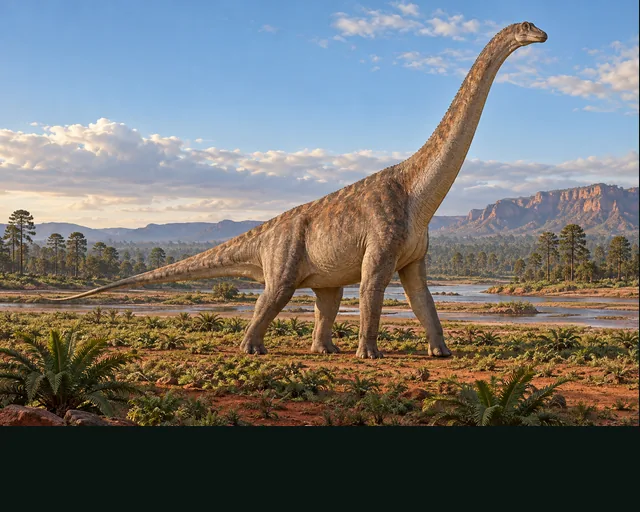
For this page, the visual reference is an existing complete restoration explicitly labelled Lapparentosaurus by the museum. We have not assembled a new external body shape from fossil photographs or substituted an unnamed relative. Nevertheless, the head and other uncertain details of that source restoration remain interpretations. Generating a more realistic surface cannot remove the underlying uncertainty.
How can a dinosaur be named without its head?
Scientific identification need not depend on finding every body part. Researchers compare the features of the material actually available, document where it came from and assess which characteristics distinguish it. A missing skull limits some questions, especially detailed comparisons of teeth and feeding structures, without making the rest of a specimen useless.
The museum credits Bonaparte with the 1986 naming of this genus. Its species name, madagascariensis, points to Madagascar. Here we use the broad sauropod identity rather than presenting a narrow family assignment as settled; a familiar-looking illustration cannot determine an animal’s position in an evolutionary analysis.
How should you read the illustration?
Notice the small restored head, rising neck, substantial trunk, four supporting limbs and long tail. The scene, skin colour and exact pose are artistic choices. In particular, a single posed neck does not establish how the animal habitually held its neck while walking, resting or feeding.
Visit Giraffatitan and Dicraeosaurus for other sauropod accounts, then use the L directory to continue browsing. These comparisons introduce different documented animals; they do not imply that their skulls were discovered with Lapparentosaurus or that all three shared one place and time.
Quick answers
- Where was Lapparentosaurus found?
- Madagascar.
- When did it live?
- During the Middle Jurassic.
- Does the museum account report preserved skulls?
- No. It describes partial skeletons lacking skulls.
- Is the illustrated face directly preserved?
- No. It belongs to an attributed artistic restoration.