Jurassic Dinos editorial · Updated · Source-based review
What was Kank australis?
Kank australis is an unenlagiid paravian dinosaur described in 2026 from the Maastrichtian Chorrillo Formation of southern Patagonia, Argentina. Paravians belong to the theropod branches close to birds. Kank adds information from southern Santa Cruz to a group whose better-known Patagonian records were concentrated farther north.
What fossils support the name?
The original abstract reports vertebrae, isolated toe bones and shed teeth. The diagnostic combination includes a strongly air-filled neck vertebra with distinctive processes, as well as an unusual bone from the second toe. This is fragmentary evidence, not a complete skeleton with a preserved living outline.
An isolated element can still be informative if researchers can compare its specific features. At the same time, different kinds of fossil evidence answer different questions. A shed tooth is not automatically a record of an entire meal, and a vertebra does not directly document the colour of the animal’s feathers.
Why was one toe bone surprising?
The study compares the second-toe element with those of troodontids, another group near the bird–dinosaur evolutionary story. It notes a resemblance in the reduced structures at the end of that bone. The authors nevertheless discuss Kank as an unenlagiid on the basis of a wider anatomical combination.
That is a useful lesson in identification. Sharing one feature with another group does not mean that every other part of the classification must follow it. Scientists ask which pattern best explains all the available characters, including features that differ from already known relatives. An incomplete specimen can therefore raise an interesting new question without answering everything about the animal.
What does our complete illustration mean?
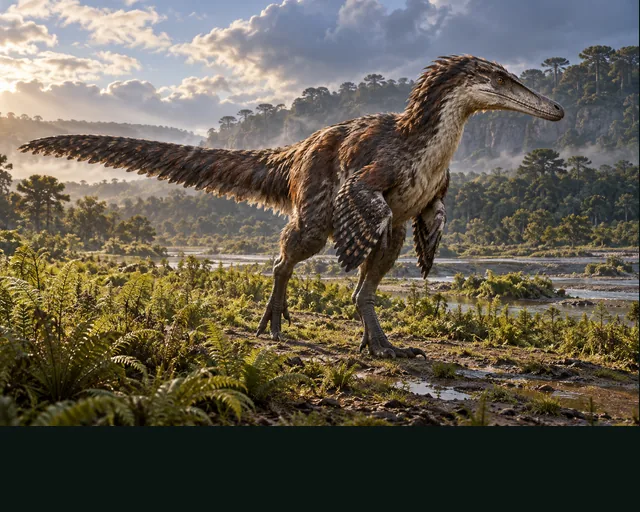
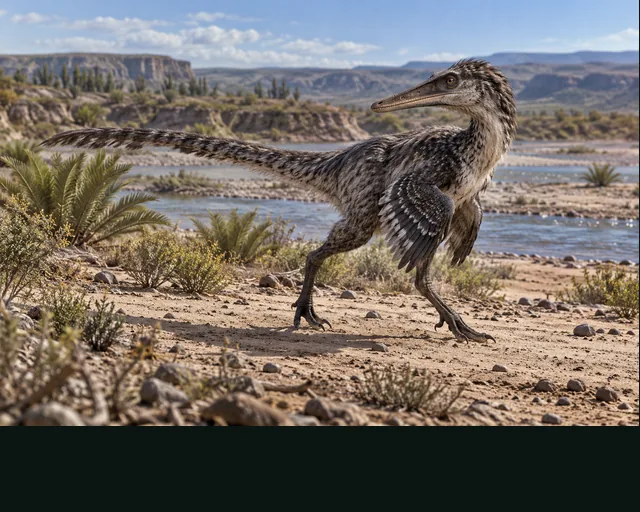
The reference is Connor Ashbridge’s explicitly named, whole-body living reconstruction of Kank. Its long narrow snout, folded feathered forelimbs, long legs and very slender tail guide our new artwork. The feather covering, unknown external proportions and russet throat are interpretations of that complete reference, not additional preserved material.
Our calm standing scene does not demonstrate a hunting technique or a particular menu. Compare Austroraptor and Buitreraptor as separately sourced accounts, then browse more names beginning with K. Keep their individual fossils distinct instead of using one relative to fill every gap in another.
Quick answers
- Where was Kank found?
- Southern Patagonia, Argentina.
- Was a complete animal discovered?
- No; the reviewed material is fragmentary.
- What year was it described?
- The paper appeared online in 2026.
- Does one troodontid-like toe make it a troodontid?
- No. The study considered a combination of features.