Jurassic Dinos editorial · Updated · Source-based review
What was Jinyunpelta?
Jinyunpelta sinensis was an armoured, plant-eating ankylosaur from the Cretaceous Liangtoutang Formation in Zhejiang, China. Two research stories make it especially interesting: the evolution of a specialised tail club and the movements used to process food. The animal had more to teach researchers than its conspicuous armour alone.
What makes a tail into a club?
The 2018 description reports interlocking tail vertebrae and a well-developed terminal knob. These are distinct components of a specialised structure, rather than simply a long tail with an impressive shape in a picture.
At the time, the discovery pushed the documented history of well-developed ankylosaur clubs further back. That is a claim about the fossil record available to those authors, not a guarantee that no earlier example will ever be discovered. It is also different from knowing precisely how one individual used its tail in a particular encounter.
How can tiny scratches reveal chewing?
A 2021 study used a confocal laser microscope to investigate wear on Jinyunpelta’s teeth. Scratch directions differed across the worn surfaces. The researchers interpreted the pattern as evidence for precise tooth contact and a two-phase jaw movement, including closure and backward motion of the lower jaw.
Think of a used cutting board: its marks can record how a tool moved even after the meal has disappeared. The analogy helps explain the question, but it is the measured fossil surface that supports the scientific interpretation. Microwear does not provide a complete list of every plant the dinosaur ate, and a reconstructed chewing motion is not a film of its final meal.
Why does this matter for ankylosaur evolution?
The study compared feeding mechanics across different armoured-dinosaur lineages. That wider comparison asks whether a particular movement appeared earlier or more often than researchers had expected. An armoured exterior therefore does not make every ankylosaur’s jaws functionally identical.
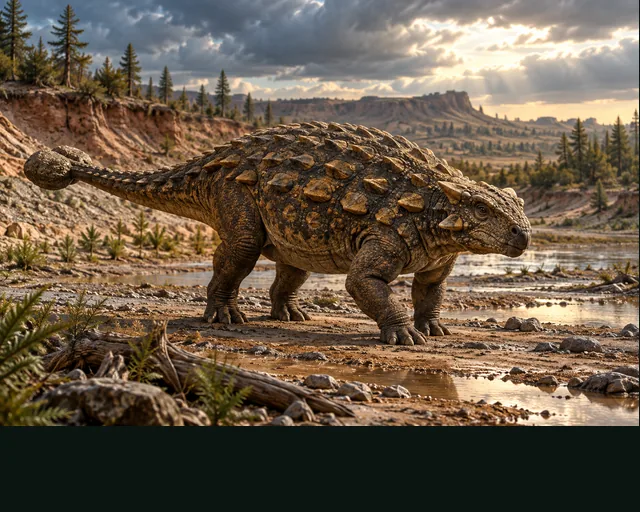
Our complete illustration follows Nobu Tamura’s named living restoration, retaining its low body, four strong legs and modest terminal club. Exact armour arrangement, colours and forest scenery remain artistic interpretation. Compare Pinacosaurus and Ankylosaurus for other armoured-dinosaur accounts, then return to names beginning with J to continue exploring.
Quick answers
- Where was Jinyunpelta found?
- Jinyun County in Zhejiang, China.
- Was its tail club only an artistic guess?
- No. The description reports specialised tail vertebrae and a knob.
- How was its chewing studied?
- Researchers examined microscopic scratches on its teeth.
- Do those scratches identify every food plant?
- No. They principally inform feeding mechanics.