Jurassic Dinos editorial · Updated · Source-based review
What was Janenschia?
Janenschia robusta was a plant-eating sauropod from the Late Jurassic Tendaguru Formation of Tanzania. Its genus name, introduced by Rupert Wild in 1991, commemorates Werner Janensch. The material had previously been assigned to Tornieria robusta, so the newer genus name does not mark a new fossil discovery. Tendaguru preserves several long-necked dinosaurs, so identifying which remains belong to which animal is part of the story, rather than a detail to skip.
Why does one leg matter so much?
The reference specimen for the name is SMNS 12144, an associated right hindlimb. It includes part of the thigh and the lower leg, ankle and foot. It is not a complete dinosaur skeleton.
A type specimen anchors a name even when it is incomplete. Additional fossils need their own reasons for being assigned to that name. Finding another large sauropod bone in the same region is a starting clue, but size and location alone do not finish the identification. It is like matching loose pieces from several similar puzzles: a good-looking fit needs checking.
Was Janenschia a titanosaur?
Older summaries, including the museum directory, place Janenschia among titanosaurs. A detailed 2019 reassessment instead recovered it as a non-neosauropod eusauropod, outside that more specialised group. The broad description “sauropod” remains useful without making the narrower placement sound settled.
The same study separated a formerly referred tail sequence as Wamweracaudia. That is a concrete reason to be cautious with older combined reconstructions and specimen lists: a collection history can contain material that later receives a different identity. Revising a fossil assignment does not erase the original discovery, but it changes which conclusions that fossil can support.
What does the complete picture represent?
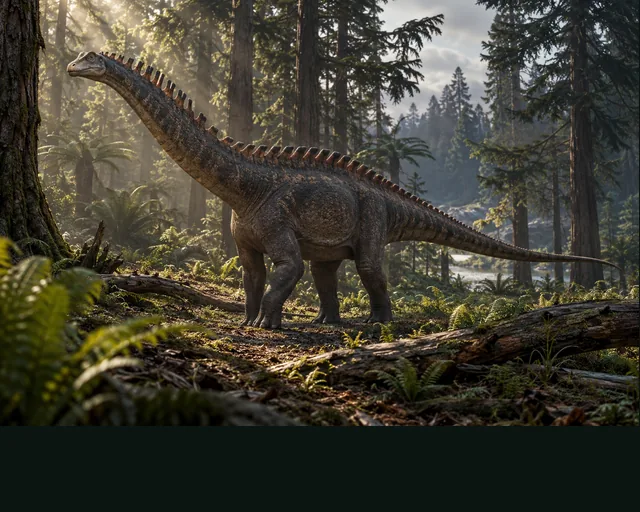
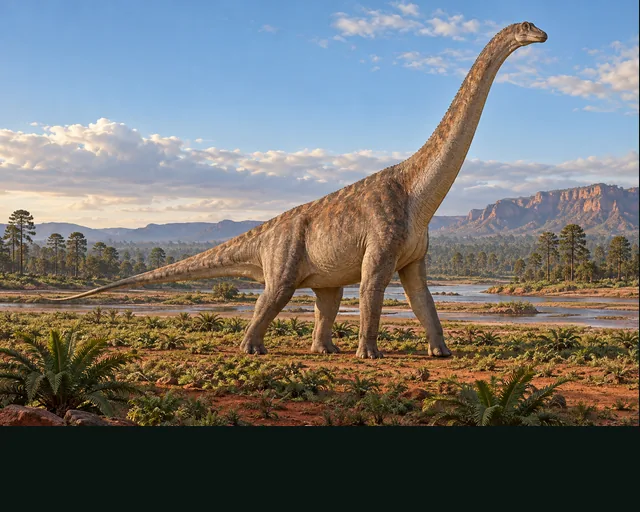
Our image follows the complete Janenschia restoration by Andrey Atuchin published by the Natural History Museum. Its small head, long neck, heavy body and four strong legs give the reader an understandable whole animal. The bumpy skin and upward-curving tail follow that artist’s interpretation. They are not a claim that every external feature is preserved in SMNS 12144.
Compare Dicraeosaurus and Giraffatitan for two other sauropod accounts connected with Tendaguru. Then browse names beginning with J, keeping each animal’s reference specimen and collection history separate.
Quick answers
- Where did Janenschia live?
- Late Jurassic Tanzania.
- What is its type specimen?
- An associated right hindlimb, SMNS 12144.
- Is it certainly a titanosaur?
- No; the reviewed reassessment placed it outside that group.
- Is the illustrated tail posture known?
- No. Its curve follows the reference artist.