Jurassic Dinos editorial · Updated · Source-based review
What was Hulsanpes?
Hulsanpes was a small theropod from the Late Cretaceous of Mongolia. Its species Hulsanpes perlei is known from the Baruungoyot Formation record. A 2018 redescription revisited the limited material and investigated its evolutionary relationships.
The study placed it among halszkaraptorines, a less familiar branch within the dromaeosaurid dinosaur story. That relationship is useful, but it should not become permission to copy every behaviour or body detail proposed for another member of the group.
What material did researchers examine?
The type includes an incomplete right hindlimb and a small braincase fragment. The redescription interpreted the latter as belonging to the inner-ear region, including parts associated with the labyrinth.
The inner ear is involved in functions such as hearing and balance. A small piece of that region can preserve useful anatomical information even when most of the head is missing. It does not provide a complete face, beak outline or external head plumage.
Why was the foot important?
The researchers identified a distinctive combination of metatarsal characters. Metatarsals are the long foot bones between the ankle and toes. Their shape and arrangement can help compare theropods whose overall skeletons are incomplete.
The study supported Hulsanpes as a valid taxon and investigated adaptations associated with movement on the ground. Such work uses the actual preserved structures rather than measuring how athletic an artist has made the animal appear.
Does its relationship prove swimming?
No. A proposed ecological interpretation for a relative should not automatically be assigned to every animal on the same branch. The redescription emphasized differences among halszkaraptorines as well as similarities.
Different limb structures may indicate different ways of using the environment. Those suggestions remain hypotheses to test with more fossils and functional comparisons. This account does not add webbed feet, a particular prey menu or a numerical running speed that the reviewed evidence does not establish.
Reading the reconstruction
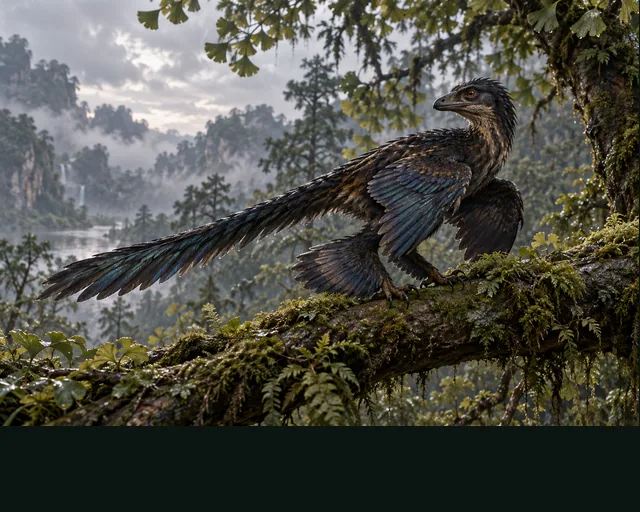
The complete approved Hulsanpes reference guided the upright neck, small head, folded feathered forearms, long hindlegs and curved feathered tail. The walking pose keeps the same partly overlapping view of the limbs.
Its striking green, pale and purple plumage, feather extent and body proportions are artistic choices. The type specimen does not preserve that complete covering. The portrait is an introduction to a poorly known animal, while the article identifies the narrower evidence used in its redescription.
Compare Velociraptor and Microraptor, then explore the H directory.
Quick answers
- What fossils are known?
- An incomplete hindlimb and a small braincase fragment.
- What did the braincase fragment contain?
- The redescription interpreted it as part of the inner-ear region.
- Was it definitely a swimmer?
- Its relationship to other halszkaraptorines does not by itself establish swimming behaviour.
- Is its striking plumage known?
- The complete portrait follows an artistic reference rather than preserved feathers in the type.