Jurassic Dinos editorial · Updated · Source-based review
What was Huaxiazhoulong?
Huaxiazhoulong was a plant-eating armoured dinosaur from Late Cretaceous Jiangxi, southern China. The species Huaxiazhoulong shouwen was introduced online in 2024 from the Tangbian Formation record.
It was identified as an ankylosaurid, a member of the broader ankylosaur radiation. Its skeleton contributes to a growing record of Chinese armoured dinosaurs, but each new taxon still needs its own diagnosis rather than borrowing distinctive traits from a nearby discovery.
What distinguished the skeleton?
The original study identified a combination of pelvic and limb features. These included details of the ischium, a bone in the pelvis, and proportions and structures in the major limb bones. Heart-shaped front tail vertebrae were also part of the comparison.
A diagnosis often depends on such relatively subtle characters. A huge spike or unusual colour in a portrait is not required. The external appearance of an armoured dinosaur can be broadly familiar while its bones preserve a distinctive combination of features.
Was the tail club actually known?
Yes. Yunnan University’s account of the discovery describes a terminal club, rather than the image adding one merely because other ankylosaurids had clubs.
However, the presence of a club does not establish the force of an impact or the exact behaviour in which it was used. Testing such questions requires additional work on anatomy and mechanics. This page does not invent a fight scene or calculate a weapon rating from the illustration.
What does an early evolutionary branch mean?
The original analysis recovered Huaxiazhoulong as an early member within Ankylosauridae. This describes the proposed branching position in a family tree. It does not mean that the individual itself was especially old or that every part of its body was an unchanged ancestral condition.
Evolution produces combinations of retained and modified traits. Researchers compare those combinations across taxa, and the results can change when new fossils or different character assessments become available.
Reading our reconstruction
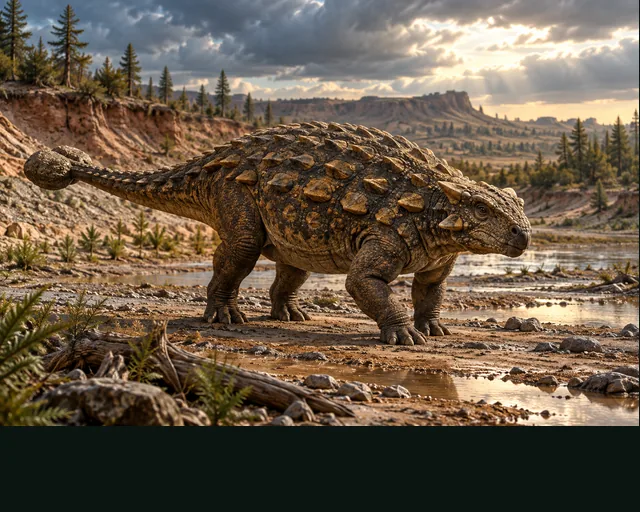
The approved complete reference guided the broad low head, heavy four-legged body, pointed armour and full tail club. The generated image was checked for coherent limbs and an uncropped club endpoint.
Exact armour spacing, soft tissues, colour and skin texture remain artistic. In particular, features described for other Jiangxi ankylosaurs, such as Datai’s distinctive cheek structures, are not automatically transferred to this species.
Compare Ankylosaurus and Pinacosaurus, then explore the H directory.
Quick answers
- Where did Huaxiazhoulong live?
- In the Late Cretaceous Tangbian Formation record of Jiangxi, China.
- Did it have a tail club?
- Yes. The research institution describes a terminal club in the discovered material.
- Is every armour plate in the portrait confirmed?
- No. The complete arrangement and soft tissues contain artistic interpretation.
- Does early branch mean an old individual?
- No. It refers to an evolutionary position, not the age of the animal when it died.