Jurassic Dinos editorial · Updated · Source-based review
What was Huadanosaurus?
Huadanosaurus was a small predatory theropod from Early Cretaceous China. Its species Huadanosaurus sinensis was described in 2025 from the Yixian Formation at Dawangzhangzi, Liaoning.
The naming study also described a different new species of Sinosauropteryx. Those separate taxonomic actions should not be combined: Huadanosaurus is not simply another spelling of the other animal named in the same paper.
What is the evidence for its food?
Mammal remains were preserved in the abdominal cavity. That supplies more direct feeding evidence than estimating diet from the general appearance of a head or from membership in a predatory dinosaur group.
The researchers examined the condition and identity of the remains to investigate the animal’s feeding ecology. However, a stomach-content sample captures a limited part of an individual’s history. It does not establish every food the species ate, how frequently it hunted each prey type or whether all age groups behaved identically.
Can we reconstruct the entire hunt?
The study discussed possible hunting strategies by combining preserved contents with anatomical comparisons. Those explanations are hypotheses about how the evidence may fit together, not a filmed record of a chase.
A small mammal in an abdomen does not by itself reveal the exact route of pursuit, time of day or sequence of movements. Such details require additional assumptions. This account emphasizes the preserved feeding evidence while avoiding a dramatic scene presented as an observed event.
What does its classification mean?
The original analysis placed the animal with other Early Cretaceous Jehol theropods in a proposed sinosauropterygid grouping. This contributes to debate over the relationships of small coelurosaurs once collected into a broad compsognathid category.
An evolutionary grouping can change as researchers test different characters and specimens. That does not invalidate the directly observed mammal remains, but it does affect broader explanations of how feeding strategies evolved among relatives.
Reading the life portrait
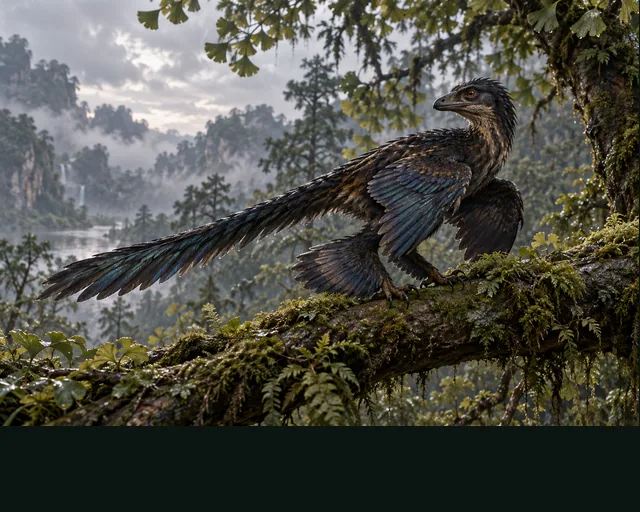
Our image follows a complete reference explicitly identified as Huadanosaurus sinensis. It retains the elongated low head, rising neck, short forelimbs, long hindlegs and tapering banded tail.
The bands and orange-brown colours are artistic choices. Pigment research on Sinosauropteryx should not be transferred automatically to Huadanosaurus. The portrait shows the animal alone rather than inventing a particular prey encounter, and it does not establish maximum speed or a complete adult size measurement.
Compare Microraptor and Compsognathus, or browse the H directory.
Quick answers
- Where was Huadanosaurus found?
- At Dawangzhangzi in Liaoning, China, in the Yixian Formation.
- What did it eat?
- Mammal remains in its abdomen provide evidence of mammalian prey.
- Does that show its entire lifetime diet?
- No. Preserved contents sample a limited feeding history.
- Are its tail bands known from pigment research?
- The image follows an artistic reference; Sinosauropteryx colour results are not automatically transferred to Huadanosaurus.