Jurassic Dinos editorial · Updated · Source-based review
What was Hexinlusaurus?
Hexinlusaurus was a small plant-eating dinosaur from Middle Jurassic Sichuan, China. Its species is Hexinlusaurus multidens. The name was introduced in a 2005 revision of small ornithischian dinosaurs from the region.
The fossils were not entirely new to science at that point. The species had previously been called Yandusaurus multidens. The revision changed how the known animal was classified, rather than turning one specimen into two different dinosaurs.
Why was it separated from Yandusaurus?
Paul Barrett and colleagues concluded that multidens was not sufficiently close to Yandusaurus hongheensis to remain in the same genus. They also found that it could not simply be transferred into another already named taxon.
That is why a new genus name was useful. A genus groups species according to a taxonomic interpretation of their relationships and distinguishing features. When that interpretation changes, one species may move while another retains the original genus name.
Was it a hypsilophodontid?
Small two-legged plant eaters were once frequently gathered into a broad hypsilophodontid grouping. The reviewed study argued that Hexinlusaurus instead represented a more early-branching ornithischian and left aspects of its precise position unresolved.
The broader term ornithischian is therefore useful here. It acknowledges a well-supported part of the relationship without claiming that every finer branch is certain. Similar body size and a running silhouette do not establish that all small plant eaters belong to one close family.
What can a naming revision teach us?
Scientific names are tools for linking observations to particular specimens. They are most useful when readers can follow which old name corresponds to which new one. Losing the species-level connection can make a catalogue count the same animal twice.
This page keeps multidens attached to Hexinlusaurus and does not rename all Yandusaurus material. It also avoids treating informal or older alternative labels as additional animals requiring identical articles.
Reading the life portrait
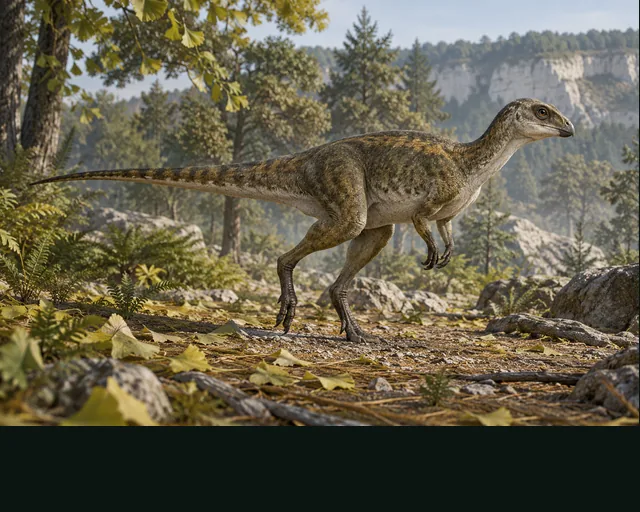
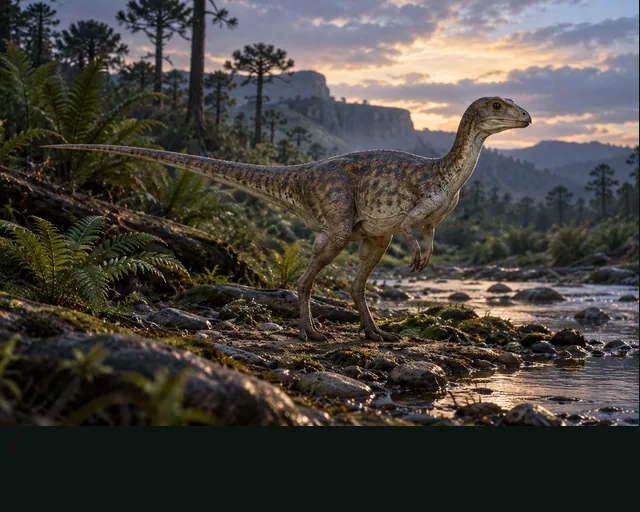
The approved complete source artwork guided the small low head, short forelimbs, bipedal running outline and long tapering tail. Its face and hands have limited visible detail, so the generated view keeps them small and partly overlapped rather than exposing invented structures.
The dark filament-like covering, colours and tail bands remain artistic. They are not a claim that this genus preserves that particular skin or feather pattern. The running pose also cannot establish a numerical maximum speed.
Compare Hypsilophodon and Lesothosaurus, or browse the H directory.
Quick answers
- What was its former name?
- The species had been called Yandusaurus multidens.
- Did all Yandusaurus change name?
- No. The revision distinguished multidens from Yandusaurus hongheensis.
- Was it a miniature Hypsilophodon?
- The reviewed study rejected that simple traditional grouping.
- Is its filament-like covering preserved?
- The complete reference uses an interpreted covering; the portrait does not establish fossil evidence for it.