Jurassic Dinos editorial · Updated · Source-based review
What was Hesperonychus?
Hesperonychus was a small predatory dinosaur from Late Cretaceous Alberta, Canada. Nicholas Longrich and Philip Currie named Hesperonychus elizabethae in 2009 from material associated with the Dinosaur Park Formation record.
It was identified as a dromaeosaurid, part of the wider group commonly called raptors. The discovery helped show that small carnivorous dinosaurs were present alongside the much larger species that dominate many popular pictures of these communities.
Why was a tiny pelvis important?
The principal specimen is a pelvic girdle, the hip region of the skeleton. Despite its small size, the pubic bones and ilia were fused. The original authors interpreted this as evidence that the individual had reached physical maturity.
That matters because a small bone does not automatically represent a small species. It might instead belong to a juvenile of a much larger animal. Evidence of maturity helped test that alternative without relying on a life reconstruction or a guess based only on size.
How was it related to other raptors?
The original evolutionary analysis placed Hesperonychus among microraptorines, a branch also including Asian dinosaurs such as Microraptor. That result suggested a wider geographical and temporal history for the lineage than the earlier Asian record alone indicated.
However, a relationship does not transfer every anatomical feature of one genus to another. The Hesperonychus pelvis does not directly preserve four wings, a complete feather arrangement or the ability to glide. Those questions need their own evidence.
Do other isolated bones belong to it?
The original study also examined small dromaeosaurid material in collections and tentatively referred some elements to Hesperonychus. Tentatively is essential: an isolated bone may resemble a known taxon without preserving enough information for a definite identification.
This account does not combine every small Alberta raptor fragment into one complete individual. Keeping firm and provisional referrals separate allows the story to improve when better specimens are discovered.
Reading the portrait
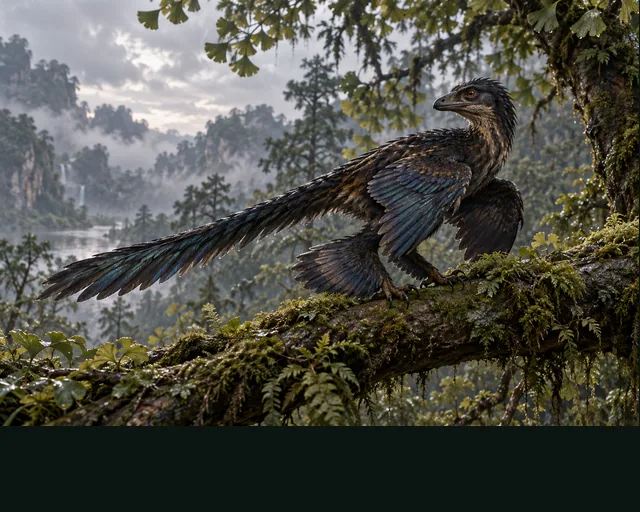
Our image follows an approved complete Hesperonychus reconstruction by Nobu Tamura. It retains the compact feathered body, small head, clawed hindfeet and long upward-arched feathered tail.
The bare red facial skin, plumage pattern, colours and exact body proportions remain artistic choices. The feathers introduce a plausible restoration rather than an additional fossil observation from the pelvic specimen. The picture is also not evidence of powered flight or a specific hunting technique.
Compare Microraptor and Bambiraptor, or browse the H directory.
Quick answers
- Was Hesperonychus simply a baby?
- The fused pelvis led the original authors to interpret the individual as physically mature.
- What is the main specimen?
- A pelvic girdle, the bones of the hip region.
- Did it have four wings like Microraptor?
- Its relationship does not directly establish that unpreserved anatomy or flight ability.
- Are all small Alberta raptor bones definitely this genus?
- No. Additional isolated referrals in the original study were tentative.