Jurassic Dinos editorial · Updated · Source-based review
What was Hagryphus?
Hagryphus was an oviraptorosaur from the Late Cretaceous of Utah. Lindsay Zanno and Scott Sampson named Hagryphus giganteus in 2005 after studying a partial specimen from the Kaiparowits Formation record.
Its discovery added to the known diversity of feathered dinosaur relatives in southern western North America. However, a complete bird-like portrait gives a much fuller impression of the animal than the fossil material itself provides.
What did the specimen preserve?
The original description included a nearly complete articulated left hand, part of a toe and additional foot fragments. Manus is the anatomical word for the hand; pedal refers to the foot.
An articulated hand preserves the arrangement of several bones together. That allows researchers to compare their shapes and contacts more effectively than a collection of unrelated fragments. Nearly complete describes the hand here, not the whole skeleton.
Why can hand bones be informative?
Different theropod groups evolved distinctive combinations of wrist and finger anatomy. Comparisons can help identify an animal even when its skull is missing. The original study compared Hagryphus with other oviraptorosaurs, including Chirostenotes.
Those comparisons should not erase the gaps. A hand may support a relationship without determining the exact shape of the head crest, the colour of the feathers or the complete proportions of the torso. A species name suggesting large size also does not replace a measured full skeleton.
Was it an egg thief?
The familiar name Oviraptor has encouraged a misleading stereotype about this wider dinosaur group. Belonging to Oviraptorosauria does not establish that every species stole eggs, and the Hagryphus hand and foot material does not provide a preserved menu.
This account leaves its diet unspecified rather than turning a group association into direct feeding evidence. Similarly, a feathered reconstruction should not be treated as proof that the animal could perform powered flight.
Reading the reconstruction
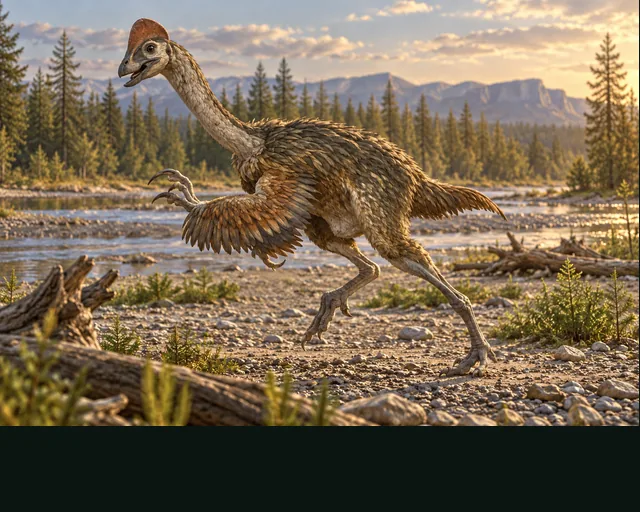
The approved complete reference guided the beaked head, raised crest, long neck, feathered forelimbs and broad tail fan. Its distinctive whole-body design is explicitly an artistic interpretation of a poorly known animal.
The crest and complete feather arrangement are not preserved on the described hand-and-foot specimen. The image’s colours, setting and display-like pose remain artistic as well. It provides a visual introduction while the text identifies which structures researchers actually examined.
Compare Chirostenotes and Oviraptor, or browse the H directory.
Quick answers
- Where was Hagryphus discovered?
- In the Late Cretaceous record of southern Utah.
- Was a crested skull found?
- The described material is hand and foot material, not a skull.
- What does manus mean?
- The hand, including its component bones.
- Did it fly?
- The feathered portrait is not evidence of powered flight.