Jurassic Dinos editorial · Updated · Source-based review
What was Haestasaurus?
Haestasaurus was a plant-eating sauropod from Early Cretaceous England. The species Haestasaurus becklesii is based on material from near Hastings in East Sussex, within the Hastings Beds Group record.
The fossils had a much older scientific history before the genus Haestasaurus was proposed in 2015. They were originally described under the name Pelorosaurus becklesii. The revision concerned that species, rather than automatically renaming every fossil ever assigned to Pelorosaurus.
Which parts of the animal are preserved?
The associated material includes a humerus, ulna and radius: the major bones of an upper arm and forearm. A skin impression is also part of the specimen’s record.
That combination offers two kinds of evidence. The bones help researchers compare limb anatomy, while the impression records something about the animal’s outer surface. Neither supplies a complete head, neck, trunk and tail from this individual.
What can a skin impression tell us?
An impression may preserve the shape and arrangement of surface structures in a particular patch. It should not be treated as a full-colour photograph. Pigment, whole-body pattern and the appearance of distant regions are separate questions.
Imagine finding the imprint of one part of a modern animal’s skin. It might reveal texture while leaving the colour and the rest of the body’s pattern unknown. The same distinction matters when a dinosaur portrait displays mottling or stripes that were chosen by an artist.
Why create a new genus?
The 2015 study re-examined the anatomy and argued that the species could be distinguished as Haestasaurus. A taxonomic revision depends on comparisons with other specimens, rather than the age of a name or the familiarity of a museum label.
The evolutionary analyses did not all agree on its precise position. Different data sets placed it in different parts of the macronarian sauropod tree. This account therefore keeps the broader relationship while explaining that the finer placement remains an issue for comparison.
Reading the life portrait
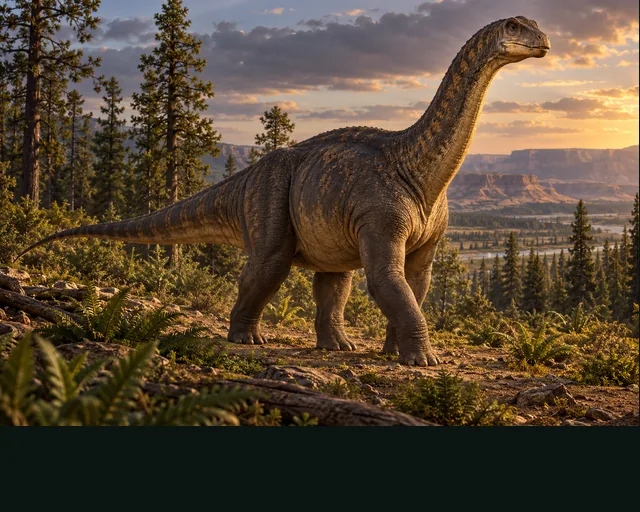
Our image follows an approved complete Haestasaurus sketch, preserving its small head, rising neck, deep torso, supporting limbs and tapering tail. The full body was not invented by extending the fossil forelimb bones.
The sketch simplifies the face, fingers and surface. The portrait’s fine textures and colours are artistic completion, and its body pattern should not be mistaken for the pattern of the preserved skin patch. No precise total length or mass is measured from this illustration.
Compare Camarasaurus and Brachiosaurus, then visit the H directory.
Quick answers
- What was the older name?
- The species was formerly called Pelorosaurus becklesii.
- What material was studied?
- Associated upper-arm and forearm bones with a skin impression.
- Does skin evidence reveal its colour?
- A skin impression does not automatically preserve pigment or a complete body pattern.
- Is its precise family position certain?
- The reviewed study recovered different placements within macronarian sauropods using different data sets.