Jurassic Dinos editorial · Updated · Source-based review
What was Gualicho?
Gualicho was a predatory theropod from the Huincul Formation of Patagonia, Argentina. Its species Gualicho shinyae was named in 2016. One of its most distinctive features is a reduced hand with only two functional fingers.
Its geological context needs an update alongside its anatomy. The original description used the traditional younger age for the Huincul Formation. A 2026 study of volcanic tuffs proposed an Albian, Early Cretaceous age for the studied formation record. This page follows that revised context without assigning the dated tuff’s exact age to the dinosaur itself.
What happened to the third finger?
The original study described a third digit reduced to a splint-like metacarpal, one of the bones within the hand. That is more precise than saying the hand simply had no trace of another digit.
Different parts of a limb can change at different rates during evolution. A reduced structure may retain evidence of its history even after it no longer forms a fully developed finger. Studying those remnants helps researchers compare the sequence of changes between lineages.
Was it related closely to Tyrannosaurus?
Two fingers alone do not establish that relationship. The Gualicho study interpreted the similar reduction in tyrannosaurids as convergence: comparable anatomical outcomes evolving independently in different branches.
The original analysis proposed a relationship with Deltadromeus and emphasized an unusual mixture of skeletal characters. That placement is an evolutionary hypothesis to be tested, rather than permission to classify the animal by its hands alone.
Why do new rock dates matter?
The age of a fossil affects comparisons with other animals and the timing of evolutionary events. If a rock unit is older than previously thought, a lineage may have been present earlier than the older literature indicated.
However, dating a volcanic layer does not directly measure the moment when every dinosaur in a formation died. Researchers must connect the dated horizon with the fossil-bearing beds. This is why the account explains the revised broad interval rather than giving a falsely exact birthday to Gualicho.
Reading our reconstruction
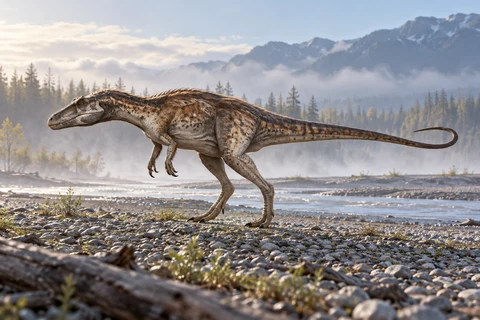
The approved complete reference guided the deep toothed head, tiny two-fingered forelimbs, long hindlegs and tapering tail. Both hands were checked for two visible clawed digits rather than a generic three-fingered theropod hand.
The spotted colour, body covering and landscape remain artistic. The picture does not establish an exact prey species, running speed or adult mass.
Compare Deltadromeus and Tyrannosaurus, or explore the G directory.
Quick answers
- How many functional fingers did Gualicho have?
- Two, with the third digit reduced to a splint-like metacarpal.
- Does that make it a tyrannosaur?
- No. The study interpreted the similar reduction as independent evolution.
- Why can its age differ between sources?
- New formation-dating research in 2026 proposed an older Albian context than the original description used.
- Are its spotted colours known?
- No. They follow an artistic full-body reference.