Jurassic Dinos editorial · Updated · Source-based review
What was Gideonmantellia?
Gideonmantellia was a small plant-eating ornithopod from Early Cretaceous Spain. Its species is Gideonmantellia amosanjuanae, described in 2012 from a skeleton discovered at Galve in Teruel.
The original study placed the fossil-bearing rocks in the Barremian interval of the Camarillas Formation. This is a different setting from the much later European communities often represented by giant duck-billed dinosaurs. Keeping the rock unit and geological interval attached to the specimen helps prevent those faunas from being mixed together.
What did the skeleton preserve?
The described specimen is a partially articulated postcranial skeleton. Postcranial means the parts behind the skull, while articulated indicates that some bones remained connected. It should not be described as a complete skeleton with a fully known head.
Connected bones help researchers investigate how different body regions relate to each other. They can also make it easier to distinguish one individual’s anatomy from a collection of isolated pieces belonging to several animals. Even so, missing regions remain missing and should not acquire invented measurements.
Why is a small ornithopod worth studying?
Large dinosaurs often dominate displays, but smaller plant eaters contribute important evidence about diversity. Their limb, pelvic and backbone features help researchers compare branches of the ornithischian family tree that do not all resemble a scaled-down Iguanodon.
A new genus is proposed through anatomical comparison, not because an illustration has a different colour or a slightly different pose. Those visible artistic differences are unsuitable for deciding whether two fossil specimens represent separate taxa.
What does the rock tell us about its environment?
The skeleton was recovered from fluvial red clays. Fluvial means related to rivers, so the sediment supplies evidence about the processes that deposited the fossil-bearing material.
That does not mean a portrait can reproduce the exact riverbank where the animal stood. Burial settings, living habitats and the place an individual died may overlap, but they are not automatically identical. A single specimen also cannot establish the full seasonal movements or social behaviour of its species.
Reading the portrait
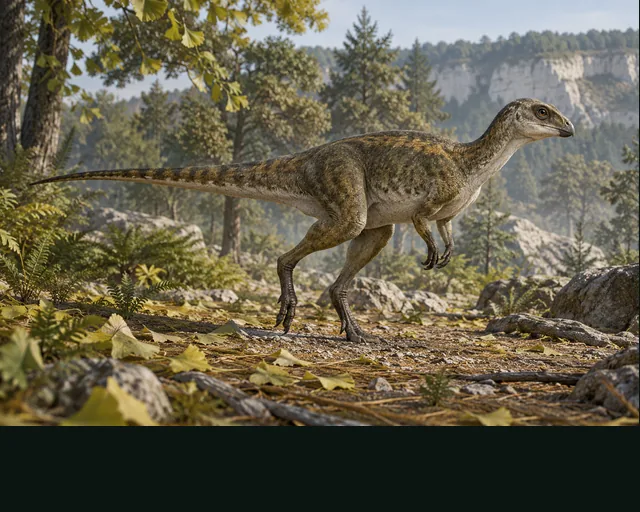
The approved complete Gideonmantellia reference guided the small beaked head, short forelimbs, bipedal outline and long tapering tail. The source reconstruction contains interpreted proportions, including features not established by the partial fossil. Mature body size is not measured from this picture.
Tail bands, skin texture, colour and landscape remain artistic choices. The portrait is a visual introduction, while the specimen description supplies the evidence for the animal’s identity.
Compare Hypsilophodon and Iguanodon, then visit the G directory.
Quick answers
- Where was Gideonmantellia found?
- At Galve in Teruel, Spain.
- When did it live?
- The original study places its Camarillas Formation horizon in the Barremian of the Early Cretaceous.
- Was the described skull complete?
- The reviewed description concerns a partial postcranial skeleton, meaning the body behind the skull.
- Does the artwork establish adult size?
- No. Its full-body proportions are an artistic reconstruction, not a mature specimen measurement.