Jurassic Dinos editorial · Updated · Source-based review
What was Genyodectes?
Genyodectes was a meat-eating theropod from Patagonia, named Genyodectes serus by Arthur Smith Woodward in 1901. Its scientific identity rests on incomplete jaw material, including parts of the upper and lower jaws with prominent teeth.
It is an important historical South American theropod, but its age and relationships have required careful re-examination. An old name can remain useful while the explanation of the specimen becomes more precise.
Why are the teeth so important?
The 2004 redescription by Oliver Rauhut examined the type material in detail. It identified an unusual arrangement of closely spaced front teeth that overlap in a staggered sequence, together with other features supporting a distinctive taxon.
Such dental characters are evidence that can be checked on the fossil itself. They are more informative than assuming that a long-toothed dinosaur must belong to whichever large predator is most familiar. Different theropod groups can evolve broadly similar feeding structures.
Where exactly did the specimen come from?
The original collection records do not provide a fully detailed geological origin. Later work concluded that the material probably came from the lower Cerro Barcino Formation in Chubut, corresponding to the Early Cretaceous.
Probably matters here. A reconstructed origin is not equivalent to a modern excavation in which the exact bed was measured and documented. This account gives the likely formation with that qualification and avoids assigning a precise age to the individual.
Why has its classification changed?
Earlier authors placed Genyodectes in several different theropod groups. The reviewed anatomical study supported ceratosaur affinities and argued that the specimen could be distinguished as a valid taxon. A later museum catalogue also noted the difficulty of resolving its exact position within Ceratosauria.
This is not a reason to make all earlier labels equally current. It is a reason to show which interpretation is supported by the reviewed material and where uncertainty remains. The limited jaws do not establish the shape of every missing body region.
Reading the reconstruction
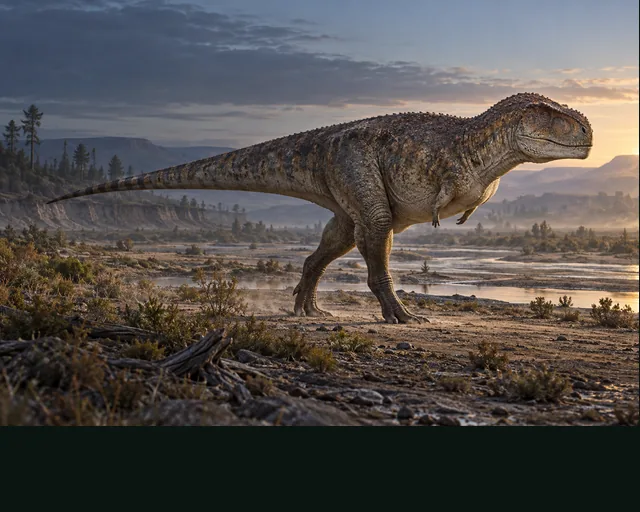
Our portrait follows a complete reference explicitly identified as Genyodectes. It retains the long deep head, small forelimbs, long hindlimbs and balancing tail. The skull completion, skin, colours and running pose contain artistic choices. Dust near a foot is scene design rather than a trace of behaviour.
The mouth is closed in this image, so the distinctive tooth arrangement is explained in the text rather than claimed to be visible in the portrait.
Compare Ceratosaurus and Abelisaurus, or explore the G directory.
Quick answers
- What is preserved?
- Incomplete parts of the upper and lower jaws bearing distinctive teeth.
- Was its rock unit recorded precisely?
- No. Later work proposed a likely origin in the Cerro Barcino Formation.
- Was it a tyrannosaur?
- The reviewed redescription instead supported ceratosaur affinities.
- Is the whole body known?
- No. Most of the complete portrait remains artistic restoration.