Jurassic Dinos editorial · Updated · Source-based review
What was Gasparinisaura?
Gasparinisaura was a small, two-legged plant-eating dinosaur from Patagonia. The species Gasparinisaura cincosaltensis is known from the Anacleto Formation of Río Negro, Argentina, in the Campanian part of the Late Cretaceous.
Its story includes an unusually revealing kind of evidence: clusters of stones preserved in the abdominal region of skeletons. These finds allow researchers to ask questions about the animal’s digestive system that bones alone cannot answer.
Why would a dinosaur swallow stones?
Stones that have been swallowed are called gastroliths. Different living and extinct animals ingest them, but finding a pebble beside a skeleton is not enough to demonstrate that behaviour. Water can carry stones into a carcass, and sediments can shift during burial.
Ignacio Cerda’s 2008 study examined clusters associated with three articulated Gasparinisaura specimens. Their position and the surrounding geological evidence supported the interpretation that they had been inside the animals. The study proposed deliberate ingestion rather than a few pebbles swallowed accidentally with food.
Do the stones prove exactly how its stomach worked?
They provide evidence of ingestion, but the precise function still requires interpretation. The arrangement of soft digestive tissues is not supplied simply by a collection of stones. Researchers compare the fossil evidence with living animals while checking where those comparisons may fail.
This distinction separates an observation from an explanation. The observation is the association of stone clusters with the abdominal region; a proposed digestive role is an explanation that must fit that evidence and other information.
What did the skull reveal more recently?
A 2026 study re-examined the holotype skull using direct observations and CT imaging. It investigated damage and crushing, reconsidered anatomical characters and proposed a placement within dryosaurid relationships.
The authors also argued that the large eye opening was probably a real feature rather than simply a sign of juvenile age. A large orbit, the opening housing the eye, should not automatically turn every small dinosaur into a baby. Growth stage needs several lines of evidence.
Reading our portrait
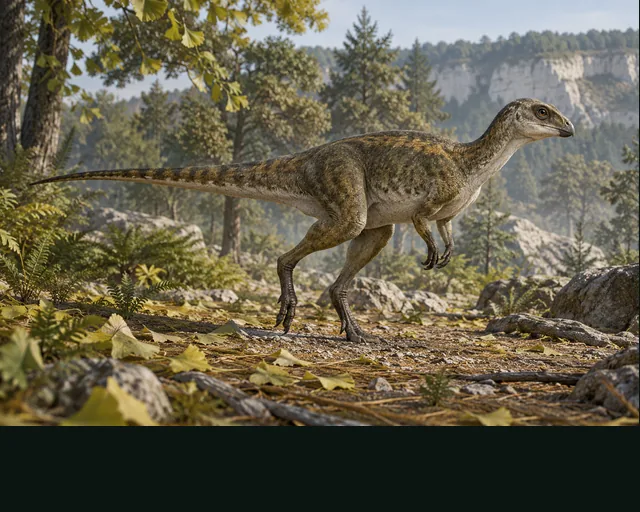
The complete approved reference guided the small head, short forelimbs, long hindlegs and narrow upward-curving tail. That tail pose is an artistic moment, not a proven habitual running posture. The mottled skin and colours are interpretations rather than preserved pigment evidence.
Compare Dryosaurus and Hypsilophodon, then browse the G directory.
Quick answers
- Where did Gasparinisaura live?
- In Late Cretaceous Patagonia, in the Anacleto Formation record of Argentina.
- What are gastroliths?
- Stones swallowed by an animal, sometimes found concentrated in the abdomen.
- Does every nearby pebble count?
- No. Researchers must test whether stones belonged inside the animal rather than entering during burial.
- Is its exact family position settled forever?
- No. A 2026 skull study proposed a revised placement among dryosaurids.