Jurassic Dinos editorial · Updated · Source-based review
What was Fosterovenator?
Fosterovenator is a theropod dinosaur name based on fragmentary leg material from the Late Jurassic Morrison Formation. Sebastian Dalman named its species Fosterovenator churei in 2014 in a study of small theropod remains from Como Bluff, Wyoming.
The site was Quarry 12, one of the historically collected localities in this famous fossil region. Unlike the complete animals often displayed in dinosaur artwork, Fosterovenator enters the scientific record through a very limited part of the skeleton.
Which bones belong to the type?
The holotype includes a nearly complete right tibia with a fused astragalus. The tibia is a major shinbone, while the astragalus forms part of the ankle. A holotype is the specimen that anchors a species name; it does not have to preserve the entire animal.
A complete right fibula from a larger individual was designated as a paratype. The fibula is the other, more slender lower-leg bone. Keeping the specimens separate matters: the larger bone does not simply extend the smaller individual’s skeleton or establish one fully measured adult body.
Why compare ankle and shin anatomy?
These bones contain shapes and proportions that can be checked against other theropods. The original paper assigned Fosterovenator to ceratosaurids. This account retains a broad theropod placement rather than presenting every finer relationship as permanently settled by the limited remains.
Fragmentary fossils can still be useful, but their limits must travel with their interpretation. A diagnostic feature of a leg bone does not reveal the precise shape of an unpreserved head, the length of both arms or the texture of the skin.
Did it hunt other dinosaurs?
The name honours the palaeontologists John Foster and Daniel Chure, and its hunter wording suggests a predatory dinosaur. However, a name is not a preserved meal. The described type does not include jaws or stomach contents that would identify particular prey.
For that reason, this page does not invent a detailed menu, maximum speed or adult body mass. Such claims would require additional evidence, not a measurement of the animal’s silhouette in a reconstruction.
Reading the complete portrait
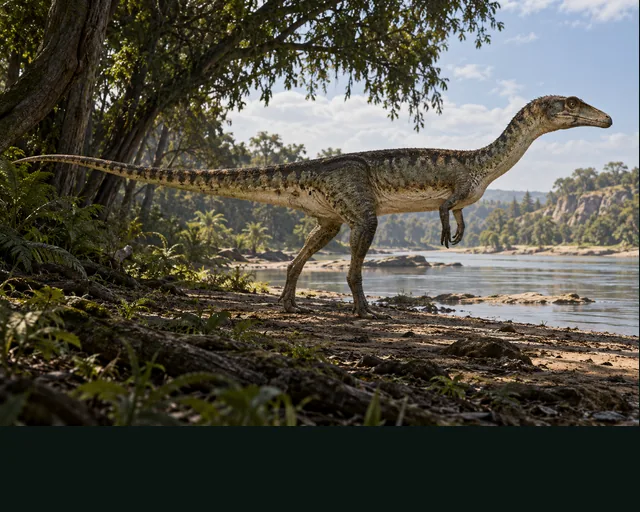
Our image follows an approved full-body artwork explicitly labelled Fosterovenator churei. Its long tail, short clawed forelimbs and low head follow that reference. The filament-like covering, stripes and most body contours remain artistic choices. No missing full-body reference was assembled from the fossil leg bones.
Compare Ceratosaurus and Elaphrosaurus, then explore the F directory.
Quick answers
- What fossils define Fosterovenator?
- The type is a shinbone with an associated fused ankle bone; a fibula from a larger individual was also referred.
- Where did it come from?
- Quarry 12 at Como Bluff, Wyoming, in the Morrison Formation.
- Is its whole appearance preserved?
- No. Most of the body in a life restoration remains interpreted.
- Does the name prove its diet?
- No. A name meaning hunter is not direct evidence of meals or tooth anatomy.