Jurassic Dinos editorial · Updated · Source-based review
What was Ferenceratops?
Ferenceratops was a plant-eating dinosaur from Late Cretaceous Romania. Its species is Ferenceratops shqiperorum. The name appeared in a 2026 revision of European dinosaur relationships, but the fossils themselves had already been studied under another name.
Previously, the species was called Zalmoxes shqiperorum and was usually placed among rhabdodontids, dinosaurs interpreted as early relatives of iguanodontians. The newer study identified it as a ceratopsian instead. This is a change in the interpretation and naming of known material, rather than the discovery of a second identical animal.
Did the whole genus Zalmoxes change name?
No. The transfer concerned the species shqiperorum. Zalmoxes robustus retained its name, and the Natural History Museum’s explanation emphasized that its relationships were less certain. Keeping the species names attached to the correct fossils prevents two encyclopedia entries from accidentally describing the same target.
A genus can include more than one species. When researchers conclude that one species belongs elsewhere, that action does not automatically remove every other species from the original genus. Taxonomic revisions need to be read at the level of the actual specimens and names involved.
Why did a European ceratopsian matter?
The 2026 research examined new Ajkaceratops material and tested a wider set of relationships. Its results supported ceratopsian identities for animals previously considered part of a distinctive European rhabdodontid fauna.
That changes the questions researchers ask about Europe’s Late Cretaceous islands. Instead of assuming that one unusual plant-eating group dominated the record, they need to investigate whether several evolutionary branches were present. The result also encourages museums to re-examine familiar specimens rather than expecting every major discovery to come from a new excavation.
Why does it not look like Triceratops?
Ceratopsia is a larger evolutionary group than the huge, heavily horned animals most people recognize. Membership does not require three spectacular horns or an enormous neck frill. A hooked beak and other anatomical features must be assessed as part of a wider comparison.
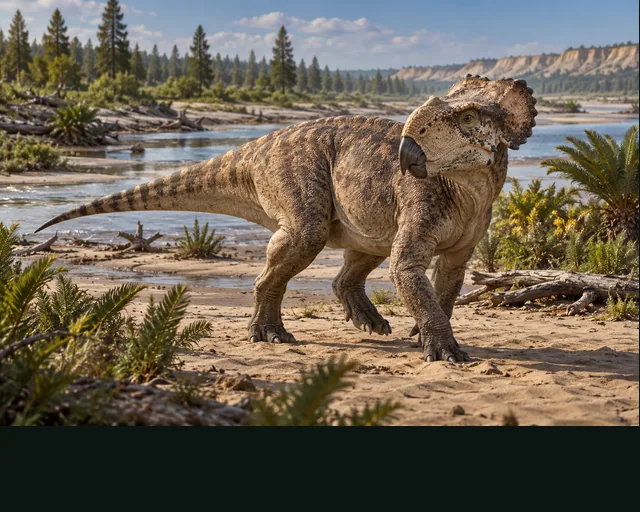
Our full-body portrait follows a reference explicitly identified as Ferenceratops under the revised interpretation. It has a low hooked beak, a robust torso and a long tapering tail. Large Triceratops-style horns have not been added to make the relationship look more familiar.
Colour, covering and exact soft-tissue contours remain artistic. The image is an introduction to the revised animal, while the sources explain why the name and family placement changed.
Compare Protoceratops and Leptoceratops, then visit the F directory.
Quick answers
- What was its previous name?
- The species was previously called Zalmoxes shqiperorum.
- Did all Zalmoxes become Ferenceratops?
- No. Zalmoxes robustus retained its name.
- Must every ceratopsian have three large horns?
- No. Ceratopsia contains a much wider variety of skull forms than Triceratops alone.
- Why was the interpretation revised?
- New material and broader anatomical comparisons changed the tested relationships of several European dinosaurs.