Jurassic Dinos editorial · Updated · Source-based review
What was Euhelopus?
Euhelopus was a plant-eating sauropod from China, with a long neck, a large trunk and four supporting limbs. Its species is Euhelopus zdanskyi. The fossils from Shandong belong to the Early Cretaceous record, although older references have assigned different ages to the deposits.
It was among the first non-bird dinosaurs described from China. Its skull has continued to attract attention long after the original naming because a familiar specimen can still contain overlooked information.
Why are sauropod skulls special finds?
Many sauropods are represented mainly by vertebrae and limb bones. A skull contains numerous relatively small elements, and those pieces may separate, become damaged or never be recovered. A large body does not guarantee that a skull will survive with it.
Euhelopus preserves an almost complete skull and lower jaw. That provides an opportunity to investigate how the mouth and surrounding structures fitted together. Almost complete is the important qualification: the 2013 reconstruction lacked a braincase, and some other elements had suffered distortion or breakage.
How did researchers rebuild the skull digitally?
Stephen Poropat and Benjamin Kear used CT scans to create three-dimensional models of individual bones. They then repositioned those models to examine their contacts. Their study also identified elements that had received little attention in earlier descriptions.
Imagine assembling a complicated object whose parts have been flattened slightly during storage. Finding that two edges no longer meet does not automatically mean that they were separate in life. Researchers must distinguish original anatomy from damage and from older restoration work. Digital models help explore alternatives while preserving the actual specimen.
Why has its family position changed?
Earlier interpretations linked Euhelopus with several Jurassic Chinese sauropods. The 2013 paper discussed analyses placing it closer to titanosaurs, within a broader group called Somphospondyli. Such a change involves rechecking many anatomical characters, not simply deciding that two animals look alike.
A proposed family tree is a testable explanation of relationships. Better descriptions can reveal that a previously coded feature was incomplete, distorted or misunderstood. This is one reason publishing detailed photographs remains useful even when a fossil has already been named.
Reading the life portrait
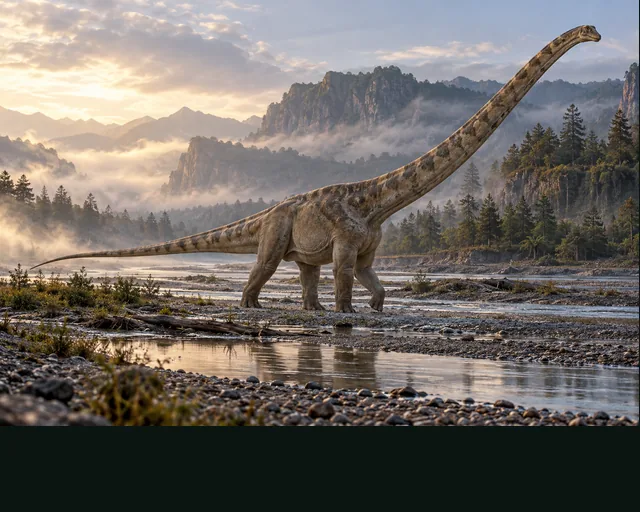
The complete approved Euhelopus reference guided the rising neck, small head, broad torso and long curled tail. The curl is not a claim that every individual habitually carried its tail that way. Skin pattern, colour and setting are artistic choices.
Compare Mamenchisaurus and Brachiosaurus, then browse the E directory.
Quick answers
- Where did Euhelopus live?
- Its fossils are from Shandong in China.
- Why is its skull important?
- Relatively complete sauropod skulls are uncommon, and this one allows many bones to be compared together.
- What did CT scanning contribute?
- It helped researchers build digital models and test how preserved skull elements fitted together.
- Does the curled tail show a known habit?
- No. The tail pose follows the complete reference and is an artistic moment.