Jurassic Dinos editorial · Updated · Source-based review
What was Erketu?
Erketu was a long-necked, plant-eating sauropod from Mongolia. Its species, Erketu ellisoni, was described by Daniel Ksepka and Mark Norell in 2006. The animal is especially interesting because of the proportions of its preserved neck bones, rather than because a complete skeleton provides every measurement of its body.
The fossils came from Bor Guvé in the eastern Gobi region. This account uses the broad Cretaceous period without attaching a precise date to the individual. The original description and later accounts of the regional rock units do not all use the same age assignment.
What did the original specimen preserve?
The first description included an articulated series from the front of the neck, an articulated lower hindlimb and a sternal plate. Articulated means that bones remained connected in their original sequence. That makes their relationships easier to examine than those of scattered pieces.
A sternal plate belongs to the chest region. Its presence adds another part of the animal to the comparison, but does not supply the missing skull, entire torso or complete tail. Researchers returned to the locality and reported additional material in a 2010 study.
How could a neck become so long?
One contribution was the unusual elongation of the neck vertebrae themselves. A vertebra is a single backbone element; extending individual elements can change the total proportions of the neck without requiring every other part of the body to grow equally.
CT scanning also revealed many internal air spaces within the vertebrae. CT produces images through an object, allowing researchers to examine hidden structures without simply cutting a specimen apart. Air-filled internal architecture is relevant to the construction of sauropod skeletons, although it does not by itself prove a particular feeding height or neck pose.
Was it a Mongolian Brachiosaurus?
Similarity in a long-necked silhouette is not enough to establish that relationship. The original study placed Erketu among somphospondylan sauropods, and the later research revisited competing ideas about Asian titanosauriform relationships. Detailed combinations of characters matter more than a shared outline.
Reading the illustration
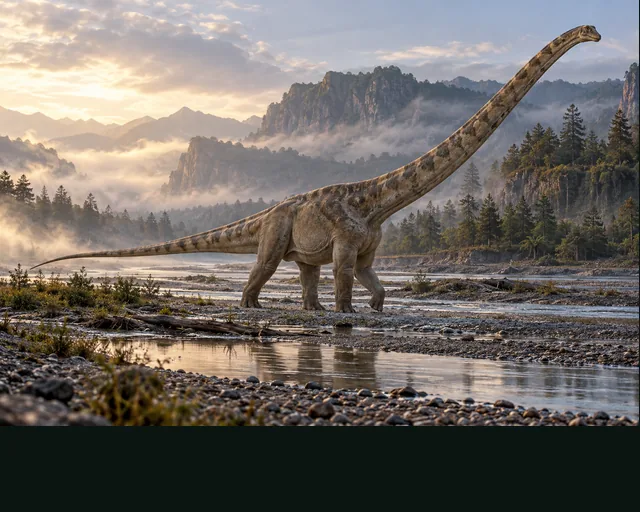
Our portrait follows an approved complete Erketu reconstruction. Its very long rising neck, small head and extended tail follow that reference. Colour, skin texture and the momentary posture remain artistic; they are not additional discoveries from the fossil specimen.
Compare Brachiosaurus and Mamenchisaurus, or explore the E directory.
Quick answers
- Where was Erketu discovered?
- At Bor Guvé in Mongolia.
- Why is its neck remarkable?
- Its preserved neck vertebrae are unusually elongated.
- Was the original skeleton complete?
- No. The original description covered a neck series, a breastbone and lower hindlimb material.
- Do we know its colour?
- The approved full-body reference and this illustration contain artistic colour choices.