Jurassic Dinos editorial · Updated · Source-based review
What was Eopinacosaurus?
Eopinacosaurus was an armoured ankylosaurid dinosaur from Late Cretaceous Asia. Its species is Eopinacosaurus mephistocephalus. The name was established in a 2026 revision of material previously assigned to Pinacosaurus.
Its Chinese fossil record is associated with the Bayan Mandahu Formation. The animal belongs to the broad story of heavily armoured plant-eaters, but understanding the name requires separating a particular species from the entire genus in which it was once placed.
What changed in the revision?
The study concluded that Pinacosaurus mephistocephalus should not remain in Pinacosaurus and established Eopinacosaurus for it. The species name continues to refer to the same historical animal, while the genus communicates a revised interpretation.
This did not rename all Pinacosaurus. The revision retained Pinacosaurus grangeri and discussed additional species-level diversity within that genus. Confusing those different actions would make two encyclopedia entries appear to concern the same animal when the study specifically distinguished them.
Why examine many specimens?
The research used newly available material to revisit the anatomy and systematics of Pinacosaurus. Comparing specimens individually can help identify variation connected with locality, geological horizon, growth or separate taxa.
An unusual feature needs to be evaluated in that context. A crushed skull, a young individual or a missing region can make one fossil look different without necessarily defining a new genus. Conversely, a familiar old label can conceal meaningful differences that become clearer in a larger comparison.
Does the name establish a new body-size measurement?
No. A taxonomic change does not automatically provide a complete living animal to measure. This account does not publish an exact length, mass or tail-club impact force from the appearance of a restoration.
Armour can be scientifically informative, but the complete arrangement visible on an illustrated back may contain interpretation. Readers should distinguish the specimen characters used in a naming study from the detailed surface completion of a life portrait.
Reading our reconstruction
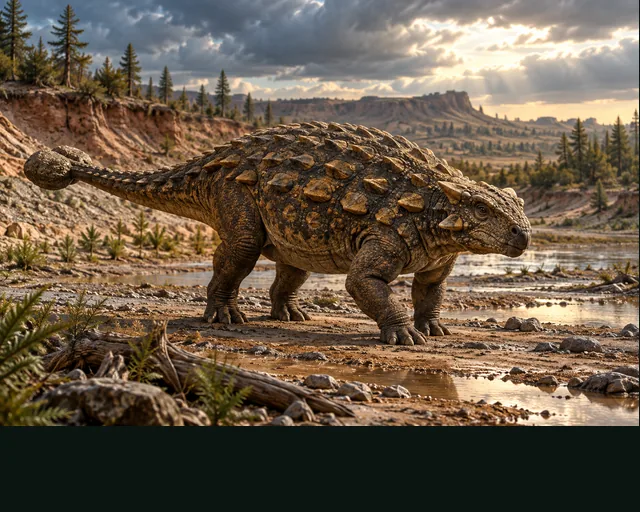
The image follows a complete reference explicitly identified as Eopinacosaurus mephistocephalus. It retains the low wedge-shaped head, broad four-legged torso, pointed armour and long tail with an enlarged tip. A generic Pinacosaurus picture was not substituted for the target animal.
The spacing of the armour, colours, soft tissues and posture remain artistic. The portrait cannot determine whether the dinosaur lived in a particular social group or used its tail in one specific encounter. It introduces the revised name while the article explains the species mapping that keeps the encyclopedia consistent.
Compare Pinacosaurus and Ankylosaurus, then browse the E directory.
Quick answers
- What was Eopinacosaurus previously called?
- Its species was previously assigned to Pinacosaurus as P. mephistocephalus.
- Did all Pinacosaurus become Eopinacosaurus?
- No. The 2026 revision separated that species while retaining Pinacosaurus for other material.
- What kind of dinosaur was it?
- An ankylosaurid armoured plant-eater from Late Cretaceous Asia.
- Does the picture verify every armour position?
- No. Armour spacing, colour and the completed body remain artistic interpretations.