Jurassic Dinos editorial · Updated · Source-based review
What was Emiliasaura?
Emiliasaura was a plant-eating ornithopod from Early Cretaceous Patagonia. Its species is Emiliasaura alessandrii. The fossils come from the Mulichinco Formation of Neuquén in Argentina, within the Valanginian interval.
Its discovery contributes to a less well sampled chapter of South American dinosaur history. The genus honours Emilia Ondetti de Fix, while the species name recognises Carlos Alessandri, according to the original research institute announcement.
Which parts were found?
The described material includes portions of the limbs, shoulder and hip regions, and tail. Researchers compared the anatomy and examined microscopic bone tissue to investigate the individuals represented.
These methods provide different kinds of evidence. External bone features can help distinguish a taxon, while internal tissue can inform an interpretation of growth stage. Neither method turns the partial remains into a complete preserved body or establishes every aspect of everyday behaviour.
Why did the original interpretation attract attention?
The naming research proposed rhabdodontomorph affinities. If that placement were correct, Emiliasaura would have important implications for the early history and geographic distribution of that ornithopod branch.
However, a striking implication depends on the underlying relationship hypothesis. It should not become a permanent superlative that remains unchanged when later research tests the animal differently.
What did the later study find?
A 2025 analysis did not recover the original rhabdodontomorph placement. Its weighted analyses instead placed Emiliasaura among early styracosternans, while also recognising limitations in the available character information and the need for further investigation.
This disagreement concerns the animal’s finer position in the family tree, not whether the fossil discovery exists. We therefore retain the broad iguanodontian ornithopod identification and explain the competing placements rather than declaring it the unquestioned oldest member of one narrow branch.
How do scientists test such disagreements?
They compare anatomical characters, reconsider how those characters are recorded and test the resulting data under different analytical assumptions. Better-preserved or overlapping specimens can help determine which interpretation is more strongly supported.
An attractive illustration cannot settle that process. A body outline may remain broadly similar even when the inferred evolutionary branch changes.
Reading our portrait
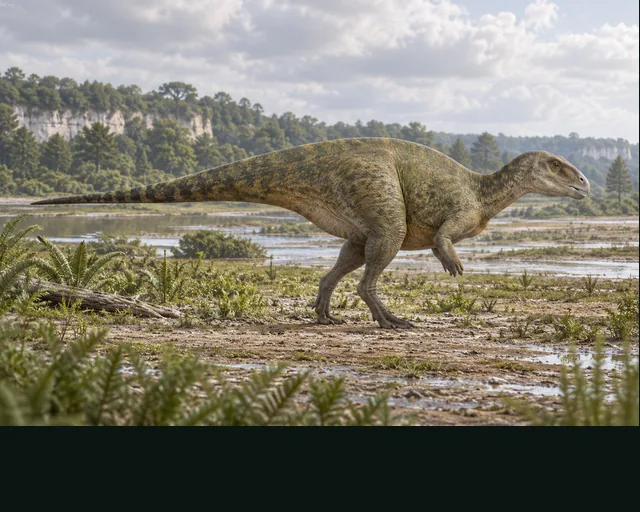
The image follows a complete reference explicitly labelled Emiliasaura. It retains the low beaked head, short forelimbs, deep torso and tapering tail. The red throat, skin texture, exact proportions and scenery remain artistic interpretations.
The portrait does not establish a complete discovered skull, an exact adult size or a known running speed. It introduces the animal while the source record explains why its place among plant-eating dinosaurs remains an active question.
Compare Rhabdodon and Iguanodon, then browse the E directory.
Quick answers
- Where was Emiliasaura found?
- In the Mulichinco Formation of Neuquén, Patagonia.
- When did it live?
- During the Valanginian part of the Early Cretaceous.
- Was it certainly the oldest rhabdodontomorph?
- No. Later research questioned that original relationship, so the superlative is not treated as settled.
- Who do its names honour?
- Emilia Ondetti de Fix and Carlos Alessandri, according to the original research institute announcement.