Jurassic Dinos editorial · Updated · Source-based review
What was Duriavenator?
Duriavenator was a meat-eating theropod from Middle Jurassic England. Its species is Duriavenator hesperis. The fossils come from Dorset, in Inferior Oolite deposits assigned to the Bajocian interval.
Its history is closely connected with Megalosaurus, a famous name that was once used for many incompletely known predatory dinosaurs. Re-examining those older assignments helps researchers separate distinct animals from a large and confusing collection of historical labels.
Why was the genus changed?
The species was previously called Megalosaurus hesperis. A 2008 redescription identified differences from the name-bearing jaw material of Megalosaurus and established the new combination Duriavenator hesperis.
A new combination means retaining the species name while changing the genus to which it is assigned. It does not mean that a second animal suddenly appeared. The physical fossil remains the evidence; the revised name communicates a different interpretation of its relationships and distinguishing anatomy.
What did the jaws reveal?
The study described a combination of characters in the upper and lower jaw regions. These included differences in tooth-bearing structures and features of the maxilla, an important upper-jaw bone.
Such anatomy is more informative than simply noting that the animal had sharp teeth. Many theropods had toothed jaws, but the arrangement of openings, grooves and supporting bones can distinguish one taxon from another. Researchers compare equivalent regions to avoid treating damage or positional differences as identifying characters.
Where does it fit among theropods?
The reviewed analysis supported tetanuran affinities. Tetanurae is a large branch containing many familiar predatory dinosaur lineages and, farther within it, birds. A broad relationship can be supported even when a fossil does not preserve every body region needed for a more complete reconstruction.
That does not provide a complete behavioural profile. Tooth form can contribute to feeding interpretation, but it does not document a particular hunt or an exact prey species. Missing body regions also limit whole-animal measurements.
Reading the portrait
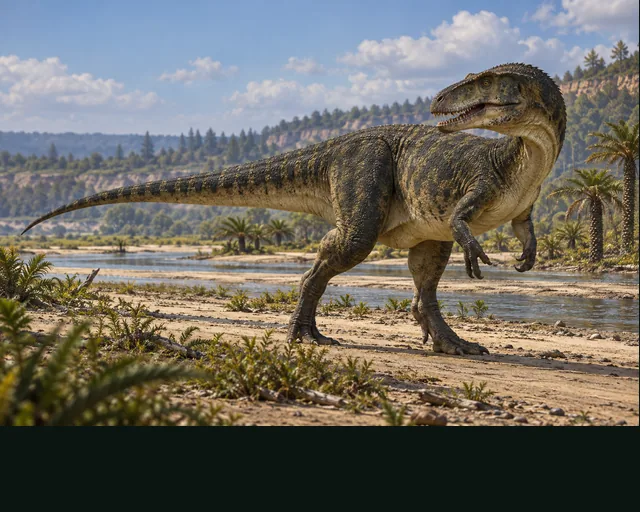
The illustration follows an approved complete restoration explicitly identified as Duriavenator hesperis. It retains the toothed head, short forelimbs, substantial hindlimbs and full horizontal tail. The complete postcranial proportions are part of the artist’s reconstruction, not a direct measurement of a complete excavated skeleton.
Colours, surface covering and the open-mouth pose remain artistic. A reader can enjoy that whole-animal view while keeping the jaw-based diagnosis and the history of the name separate from the imagined scene.
Compare Megalosaurus and Allosaurus, then browse the D directory.
Quick answers
- Where was Duriavenator found?
- In Dorset, England, in Middle Jurassic Inferior Oolite deposits.
- Was it once called Megalosaurus?
- Yes. The species hesperis was later moved into the separate genus Duriavenator.
- Which bones supported the change?
- The reviewed study identified informative differences in the preserved jaws.
- Is the complete body directly known?
- The whole-body portrait contains artistic completion; jaw evidence does not establish all postcranial proportions.