Jurassic Dinos editorial · Updated · Source-based review
What does Dromaeosauroides refer to?
Dromaeosauroides is a dinosaur name established from a tooth found on Bornholm, Denmark. The species is Dromaeosauroides bornholmensis. Its history is an opportunity to ask how much a small fossil can reveal, and when a scientific name needs cautious treatment.
This is a name explanation rather than a claim that another separately identifiable dinosaur body has been established. The tooth remains an important part of the Danish fossil record even where its diagnostic value is questioned.
What was the original discovery?
The tooth was found at Robbedale in 2000 and described in 2003. It came from Early Cretaceous deposits associated with the Jydegaard Formation. The original researchers compared it with the much younger North American Dromaeosaurus, while identifying reasons not to assign it to that same genus.
Teeth can preserve shape, curvature and serration patterns that help identify broad groups. However, a tooth is not a miniature complete skeleton. It cannot reveal every limb proportion, skull outline or feather arrangement of the animal that carried it.
Why is the name treated cautiously here?
A later primary study described the naming crown as indeterminable. That challenges how confidently the fossil can distinguish a particular genus. This account therefore does not count Dromaeosauroides as an additional securely established animal or include it in body-size comparisons.
The later study also concerns other Bornholm teeth from the Rabekke Formation. Those records must remain separate from the Jydegaard naming tooth. Sharing an island does not make every tooth part of the same specimen or species.
Does uncertainty make it Dromaeosaurus?
No. Questioning a name’s diagnosis does not automatically identify the fossil as a different familiar genus. A resemblance can support a broad comparison without establishing an exact identity or a formal synonym.
This distinction helps avoid a common mistake: replacing one uncertain answer with another confident-looking answer that lacks evidence. The appropriate conclusion may remain a broader dromaeosaurid affinity rather than a precise genus assignment.
What does the illustration represent?
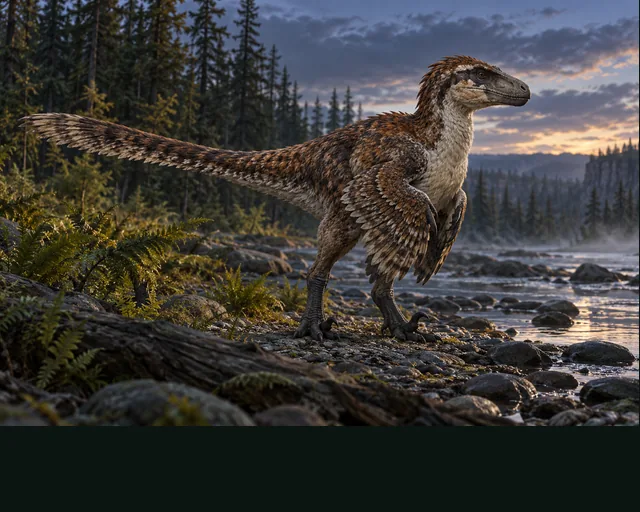
Our picture follows an existing complete restoration explicitly labelled Dromaeosauroides. The reference itself describes the body as hypothetical. It is not a Dromaeosaurus picture relabelled for this page, and no skeletal fragment was used to generate a body from scratch.
Its feathered head, limbs, tail, colours and proportions are artistic interpretations of a named hypothesis. They must not be treated as anatomy discovered with the tooth. Keeping the name history and image limitations together lets readers appreciate the Danish discovery without inventing certainty.
Compare Dromaeosaurus and Velociraptor, then browse the D directory.
Quick answers
- What is the name based on?
- A dromaeosaurid-like tooth crown from Bornholm.
- Is its separate genus beyond dispute?
- No. A later primary study questioned the tooth’s ability to identify a genus.
- Is it simply Dromaeosaurus?
- That identity is not established; resemblance is not the same as a demonstrated synonym.
- Is the full-body image a fossil discovery?
- No. It is a hypothetical named restoration and does not establish missing anatomy.