Jurassic Dinos editorial · Updated · Source-based review
What was Doolysaurus?
Doolysaurus was a small dinosaur from Cretaceous South Korea. Its species is Doolysaurus huhmini, described in 2026. The fossils come from the Ilseongsan Formation on Aphaedo, also called Aphae Island.
The discovery is notable because Korea’s dinosaur record contains many footprints and eggs, but comparatively few skeletons. Different kinds of fossils answer different questions. A track records contact with a surface, while a skeleton can preserve identifying anatomy that a footprint cannot show.
Was the animal fully grown?
The researchers combined body size, anatomical features and microscopic bone evidence to interpret the specimen as immature. That matters when reconstructing it: a young individual is not simply a perfectly scaled miniature of a known adult.
Growth can affect proportions and bone structure. The discovery therefore does not establish every feature of a mature Doolysaurus, and this account avoids giving the adult an exact size based only on the juvenile portrait.
How could scientists see inside the rock?
The partial skeleton is preserved in associated blocks containing both head and body material. Researchers used micro-computed tomography, or micro-CT, to investigate internal anatomy. This technique builds a view from many X-ray measurements and can reveal structures that are difficult to examine from the exposed surface alone.
Scanning does not remove the need for interpretation. Researchers still have to identify bones, distinguish damage and compare anatomical characters. In this case, the resulting information contributed to identifying Doolysaurus as an early-branching neornithischian, recovered as a thescelosaurid in the analysis.
What were the associated stones?
The specimen includes gastroliths, stones associated with the digestive region. Their form and relative mass were used to propose a more omnivorous diet. That is an ecological interpretation, rather than direct preservation of every food the animal ate.
A stone should not automatically be treated as proof of one particular meal or a modern bird-like digestive system. Its association and characteristics must be evaluated together with the rest of the evidence.
Reading our image
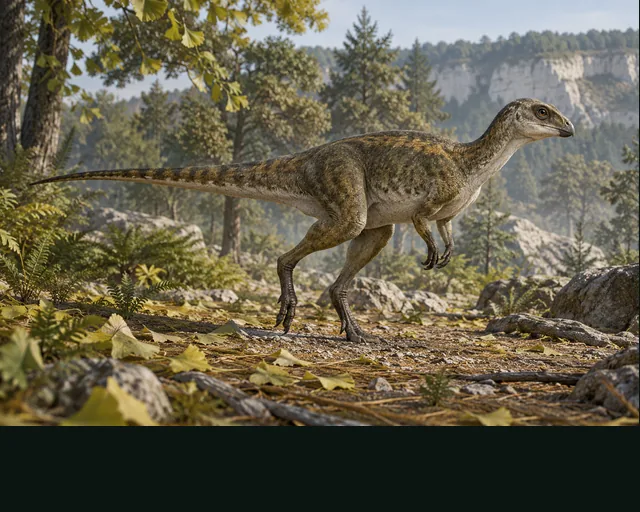
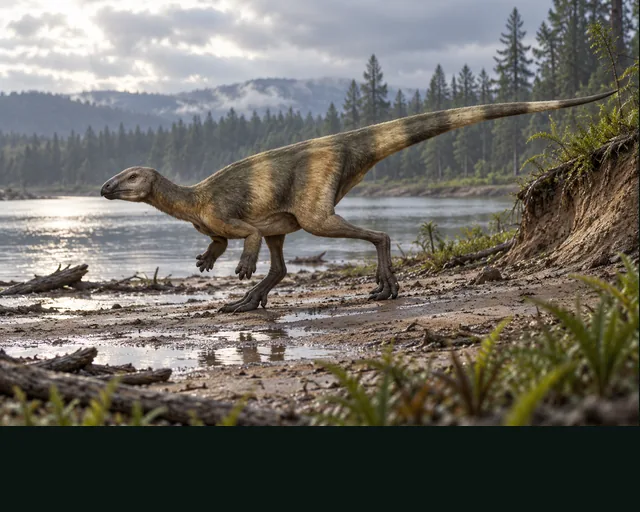
The illustration follows the complete small foreground animal in the approved restoration. The much larger partial neighbour and distant animals are separate subjects and were not used to supply Doolysaurus anatomy.
The rounded feathered appearance, colours and detailed soft tissues remain artistic interpretations. The image introduces a young animal without claiming its covering or adult proportions are completely known. Its appeal is paired with a source record explaining the scans and growth evidence behind the discovery.
Compare Oryctodromeus and Hypsilophodon, then explore the D directory.
Quick answers
- Where was Doolysaurus found?
- On Aphaedo in South Korea, in the Ilseongsan Formation.
- Was it fully grown?
- No. Anatomy and bone tissue indicate an immature individual.
- What did scanning add?
- Micro-CT helped reveal bones and anatomical details within the rock.
- Was it certainly an omnivore?
- Its associated stones helped support that proposal, but they do not preserve a complete menu.