Jurassic Dinos editorial · Updated · Source-based review
What was Diuqin?
Diuqin was a birdlike theropod from Late Cretaceous Patagonia. Its species is Diuqin lechiguanae, described in 2024. The fossils come from the Bajo de la Carpa Formation of Neuquén in Argentina, within the Santonian interval.
Its discovery helps fill part of the fossil record of unenlagiine-related dinosaurs. That record contains long gaps and many incomplete specimens, making each informative new bone useful for comparing animals from different times.
How complete is the evidence?
Diuqin is known from a very incomplete postcranial skeleton. Postcranial means the parts behind the skull. The preserved bones differ from equivalent elements in other related dinosaurs, supporting recognition of a separate taxon.
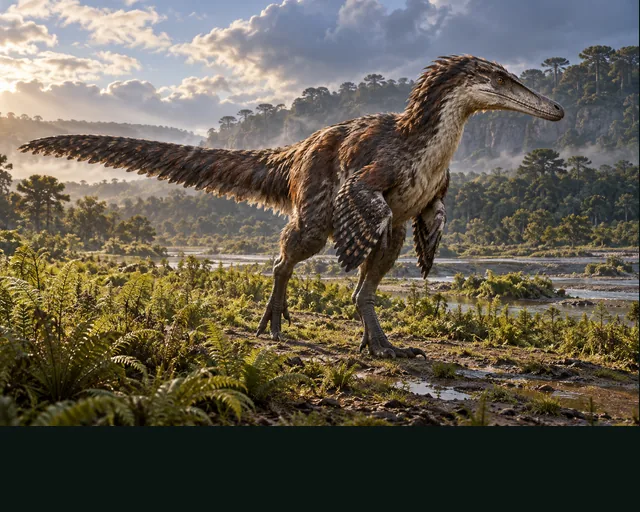
A limited skeleton does not provide an equally detailed answer to every question. It may preserve identifying features without establishing a complete head shape, exact body length or entire feather arrangement. Those limits remain important even when a finished illustration looks convincing.
Why study its upper arm?
The humerus is the upper-arm bone. The study compared Diuqin’s humeral anatomy with that of older and younger unenlagiine-related animals. Some features appeared intermediate between forms from different geological intervals.
Intermediate anatomy can be informative about evolutionary change. It does not prove that one named animal was the direct parent or ancestor of another. The family-tree analysis allowed several positions within Paraves, with the strongest connection to Unenlagiinae, rather than resolving every relationship beyond doubt.
What made the punctures interesting?
Near one end of the humerus, the researchers described rounded punctures interpreted as feeding traces. A feeding trace can record an interaction with remains after death as well as a possible attack during life. The mark alone does not supply a complete sequence of events.
Several potential makers were considered, including crocodile relatives, mammals and theropods. We therefore do not turn the discovery into a definite story of one predator killing Diuqin or of confirmed cannibalism. Distinguishing the observation from possible explanations keeps the evidence useful.
Reading the whole-animal portrait
Our image follows a complete reference explicitly identified as Diuqin lechiguanae. It retains the elongated toothed snout, feathered forelimbs, hindlimbs and long feather-tipped tail. The skull completion, exact proportions, colours and feather covering are artistic interpretations.
The scene does not show the animal responsible for the fossil marks, because that identity is unresolved. Instead, it introduces the living animal while the article explains the separate anatomical and ecological questions raised by its remains.
Compare Austroraptor and Velociraptor, then browse the D directory.
Quick answers
- Where was Diuqin found?
- In the Bajo de la Carpa Formation of Neuquén, Argentina.
- How complete is the fossil?
- It is a very incomplete skeleton from behind the skull.
- What made the arm bone interesting?
- Its anatomy informs comparisons, and punctures near one end were interpreted as feeding traces.
- Do we know which animal made the marks?
- No. The study considered several possibilities rather than identifying a definite attacker.