Jurassic Dinos editorial · Updated · Source-based review
What was Dineobellator?
Dineobellator was a dromaeosaurid theropod from New Mexico in the southwestern United States. Its species is Dineobellator notohesperus. The fossils date to the Maastrichtian, near the end of the Late Cretaceous.
It contributes to the record of raptor-like dinosaurs in southern North America. These animals were diverse, and a newly identified species should not automatically be treated as a small copy of a famous northern relative.
Which parts are known?
The animal is represented by a partial skeleton with material from several body regions. The original description and a later reassessment examined features of the forelimbs, claws and tail, among other remains.
The reassessment reinterpreted some bones and described additional material, including a claw tentatively identified as belonging to the third finger. Tentative identification is useful information: it tells readers which assignment remains less certain rather than hiding that uncertainty beneath a finished drawing.
What might the arms and tail reveal?
The studies used anatomical features to discuss differences in forearm use, gripping and movement near the tail base. Such interpretations can help researchers investigate how related predators might have functioned differently.
However, a proposed functional advantage is not a direct measurement of an extinct animal’s performance. We cannot turn a claw shape into a precisely known grip force, or a tail joint into a recorded turning speed, without additional modelling and assumptions.
Did its family-tree position change?
The original analysis placed Dineobellator within Velociraptorinae. The later reassessment recovered it as a dromaeosaurid outside previously named narrower clades. This account therefore keeps the broader identification while explaining the difference between studies.
That is a normal example of a hypothesis changing as anatomy is re-evaluated. A family tree is a tested arrangement of evidence, not a permanent label determined by the appearance of one illustration.
What about damaged bones?
Several bones show abnormal growth that researchers interpreted as pathological, potentially resulting from injury or disease. Such traces can provide clues about an individual’s life. They do not, by themselves, identify the exact event or opponent responsible.
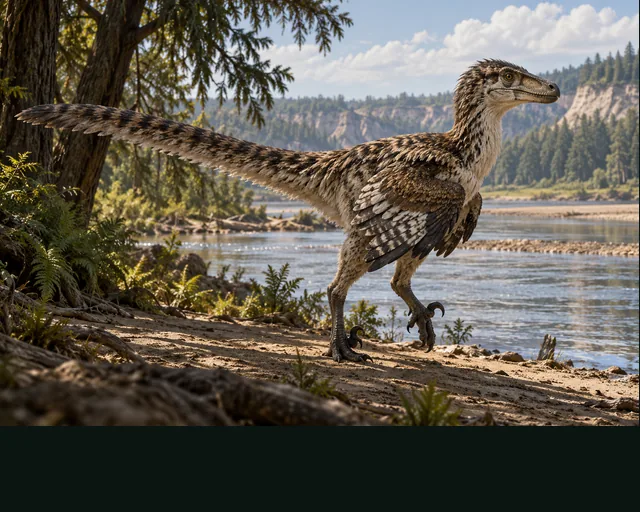
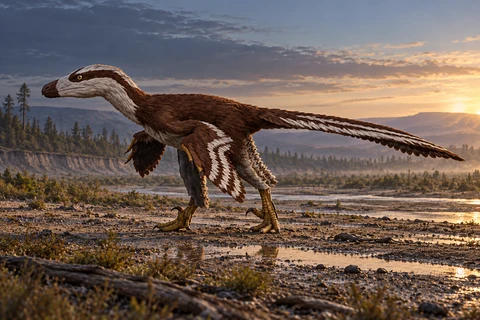
Our portrait follows a complete reference by Nobu Tamura, retaining the feathered forelimbs, long hindlimbs and full feathered tail. The bright facial colour, feather pattern and running pose remain artistic. They are not evidence of known plumage colours or a documented hunt. The whole-animal view is paired with source notes so that anatomical findings remain separate from the imagined scene.
Compare Deinonychus and Acheroraptor, then browse the D directory.
Quick answers
- Where did Dineobellator live?
- Its fossils come from latest Cretaceous New Mexico.
- Was a complete skeleton found?
- No. It is represented by a partial skeleton containing several informative body regions.
- Is it certainly a velociraptorine?
- The original and later analyses differ, so this account retains the broader dromaeosaurid identification.
- Do its claws prove an exact grip force?
- No. Anatomical features support functional interpretations, not a directly measured force from a living animal.