Jurassic Dinos editorial · Updated · Source-based review
What was Demandasaurus?
Demandasaurus was a plant-eating sauropod from Early Cretaceous Spain. Its species is Demandasaurus darwini. The fossils come from the Castrillo la Reina Formation of Burgos, within the late Barremian to early Aptian interval.
It belonged to the rebbachisaurids, a branch of diplodocoid sauropods. This connects it with the wider evolutionary story of long-necked herbivores, while distinguishing it from other sauropod groups that may look broadly similar in a life reconstruction.
What was actually discovered?
The naming study described an incomplete but associated skeleton that includes both cranial and postcranial remains. Cranial material belongs to the head; postcranial material comes from behind it. Preserving parts of both regions supplies several kinds of information for comparison.
The study identified a distinctive combination of tooth and vertebral features. Vertebrae are the bones of the backbone. Small differences in teeth and the architecture of a vertebra can help distinguish animals whose completed silhouettes might otherwise look alike.
Why compare it with Nigersaurus?
The original analysis recovered a close relationship with Nigersaurus from Africa. That connection was based on shared anatomical characters, not simply the presence of long necks or the fact that both ate plants.
Related genera remain separate named animals. A comparison does not justify giving Demandasaurus every specialised feature of the better-known Nigersaurus skull. Our illustration therefore uses a complete reference explicitly identified as Demandasaurus, rather than relabelling an African relative’s picture.
What does this suggest about ancient geography?
The research discussed possible connections between southern Europe and northern Africa during the Early Cretaceous. Dinosaur relationships can contribute evidence to questions about exchanges between ancient land areas.
However, a proposed route is a hypothesis tested using geology, fossil ages and multiple animals. It is not a documented journey made by the individual found in Burgos. Modern coastlines also cannot be assumed to match the geography of the Cretaceous.
Reading our whole-animal view
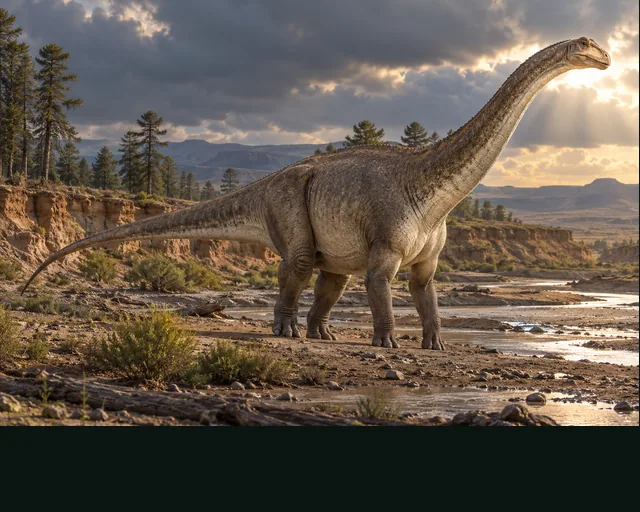
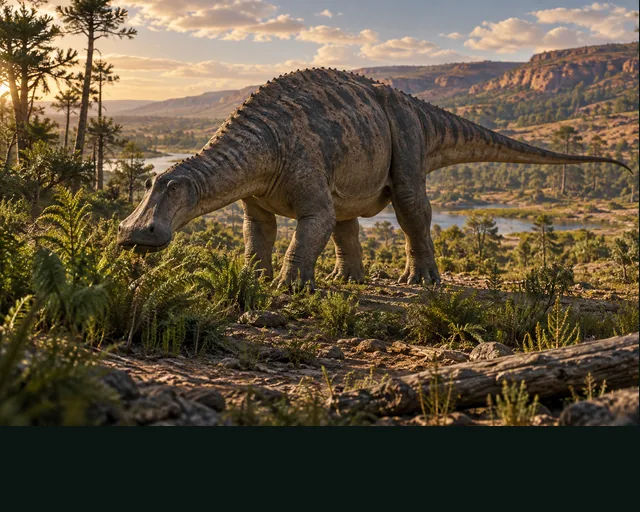
The approved complete reference retains the entire tail, including its upward-curled tip. Our portrait follows its low head, long neck and four-legged body. The curled pose, green colours and soft tissues remain artistic interpretations rather than preserved observations of the living animal.
Ground vegetation covers the distal toe region because the reference does not resolve that detail. We keep that limitation instead of inventing an unsupported close view of the feet. The image provides an accessible introduction while the article explains the tooth and backbone evidence that makes this Spanish dinosaur scientifically distinctive.
Compare Nigersaurus and Limaysaurus, then explore the D directory.
Quick answers
- Where was Demandasaurus found?
- In Burgos, Spain, in the Castrillo la Reina Formation.
- What kind of sauropod was it?
- A rebbachisaurid, part of the diplodocoid sauropod branch.
- Was it the same as Nigersaurus?
- No. The naming analysis found a relationship, not an identity between the genera.
- Why are its toes hidden in the image?
- The complete reference does not resolve distal toe detail, so vegetation is retained rather than inventing it.