Jurassic Dinos editorial · Updated · Source-based review
What was Daurlong?
Daurlong was a dromaeosaurid dinosaur from Early Cretaceous China. Its species is Daurlong wangi, described in 2022. The fossil comes from Inner Mongolia and belongs to the wider Jehol record of exceptionally preserved animals.
Dromaeosaurids are the birdlike theropods often called raptors. That nickname can be useful, but it should not make every member a copy of Velociraptor or a modern bird of prey. Their anatomy and fossil preservation can differ in scientifically important ways.
What was preserved inside its body?
The study described a large bluish layer in the abdominal region and interpreted it as intestinal remnants. The intestine is part of the digestive tract through which food passes after leaving the stomach. Such soft-tissue evidence is rare among non-avian dinosaurs.
This does not mean the fossil preserves every organ as an unchanged miniature body. Researchers interpret the location and form of surviving material in relation to anatomy. A dark or coloured patch needs explanation before it can be identified as a particular tissue.
Why compare it with another dinosaur?
The study compared the position of Daurlong’s intestinal evidence with the unusually preserved digestive region of Scipionyx. That comparison helped investigate whether the general organisation of the digestive tract remained relatively conservative among meat-eating theropods.
Conservative in this context means retaining a broadly similar arrangement over evolutionary time. It does not mean that every animal ate the same food or possessed identical organs. Nor does a digestive comparison require using another dinosaur’s image to reconstruct Daurlong.
Where does it fit in the family tree?
The analysis placed Daurlong among a lineage of short-armed Jehol dromaeosaurids, closer to eudromaeosaurs than to microraptorines. These labels describe branching relationships inferred from anatomical characters.
A feathered silhouette alone does not determine that position. The same caution applies to flight: having feathers does not establish that an animal could perform powered flight. Its skeleton and feather arrangement must be considered for that separate question.
Reading our portrait
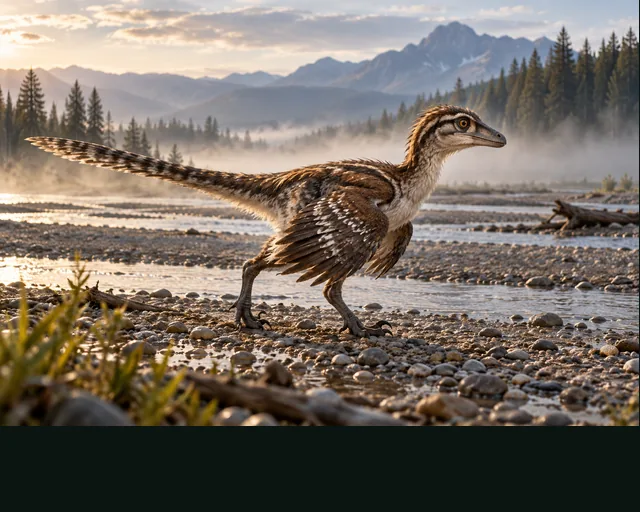
The picture follows Ivan Iofrida’s complete restoration specifically identified as Daurlong wangi. It retains the long feathered head and neck, feathered limbs and complete tail. The brown and green colours, precise covering and running pose remain artistic interpretations.
The bluish fossil layer is not used to colour the living animal blue, and it does not reveal a specific last meal in this account. The illustration introduces the whole animal while the article explains the unusual internal evidence that makes this discovery distinctive.
Compare Microraptor and Bambiraptor, then explore the D directory.
Quick answers
- Where was Daurlong found?
- In Inner Mongolia, China, within the Early Cretaceous Jehol fossil record.
- What was unusual about its abdomen?
- A preserved bluish layer was interpreted as remnants of the intestinal tract.
- Does blue preservation mean blue skin?
- No. A fossil tissue layer’s present appearance does not identify the living animal’s outer colour.
- Did it fly like a bird?
- Feathered restoration and birdlike relationships do not by themselves establish powered flight.