Jurassic Dinos editorial · Updated · Source-based review
What was Datai?
Datai was an armoured plant-eating dinosaur from southeastern China. Its species is Datai yingliangis, described in 2024. The fossils come from Jiangxi, in the Zhoutian Formation of the regional Ganzhou succession, during the earlier part of the Late Cretaceous.
It belongs to the ankylosaur story: dinosaurs famous for bony body armour and, in some branches, specialised tails. However, the familiar image of an enormous adult with a heavy tail club should not be applied automatically to every incomplete or immature ankylosaur fossil.
What was unusual about its cheeks?
The naming study identified doubled horns on the quadratojugal region of the skull. The quadratojugal is a bone near the back of the cheek. The researchers also described extensive gular osteoderms. Gular means associated with the throat, and osteoderms are bony structures formed in the skin.
These features help distinguish Datai from related animals. They are anatomical characters that can be studied and compared, rather than merely decorative choices made by an illustrator.
Why does the animal’s age matter?
The naming material represents immature animals. A young dinosaur may differ from a fully grown member of the same species in proportions, bone fusion and the development of ornament. That makes growth stage an essential part of interpreting the specimen.
Immaturity does not mean that a fossil cannot be named or studied. It means that researchers must separate useful identifying traits from features that might change during growth. A restoration should likewise avoid presenting an imagined adult as though every adult structure had already been discovered.
Where does Datai fit among ankylosaurs?
The original analyses connected it with early Asian ankylosaurine branches or placed it close to Pinacosaurus, depending on the analysis. That variation reflects the difficulty of resolving relationships when some anatomical information is missing or affected by growth.
The finding helps expand the record of armoured dinosaurs from southeastern China. It does not establish that one named juvenile was the direct ancestor of a later genus, or that all related dinosaurs shared identical armour patterns.
Reading our image
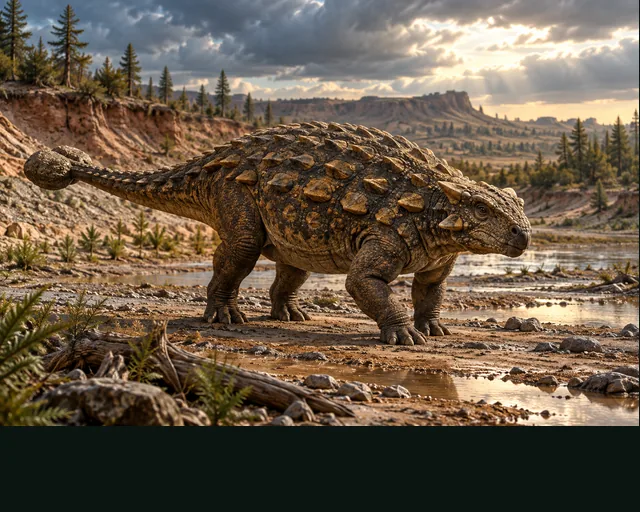
The portrait follows a complete reference specifically identified as Datai yingliangis. It retains the low head, deep armoured torso and long tail, including the reference artist’s modest swelling near the tip. That swelling is not presented as a preserved adult tail club.
The full distribution of armour, completed body proportions, colours and landscape remain artistic interpretations. The image introduces the animal while the text preserves the growth-related limits that make its fossils an interesting scientific puzzle.
Compare Pinacosaurus and Ankylosaurus, then explore the D directory.
Quick answers
- Where was Datai found?
- In Jiangxi, southeastern China, in the Zhoutian Formation within the regional Ganzhou succession.
- What was distinctive about its head?
- The study identified doubled horns on the quadratojugal cheek region.
- Were the naming animals fully grown?
- No. Their immature status is an important limitation when interpreting adult appearance.
- Does the illustration prove it had an adult tail club?
- No. The reference’s small distal swelling is artistic and does not establish adult club development.