Jurassic Dinos editorial · Updated · Source-based review
What was Dasosaurus?
Dasosaurus was a plant-eating sauropod from northeastern Brazil. Its species is Dasosaurus tocantinensis, described in a 2026 study. The fossils come from Early Cretaceous deposits associated with the Itapecuru Formation, within the Aptian interval.
Its long-necked body belongs to the broad titanosauriform story, but that word should not be shortened automatically to titanosaur. The reviewed analysis placed Dasosaurus among somphospondylans outside Titanosauria. These are nested evolutionary groups, and their similar names can conceal important distinctions.
Which bones helped establish its relationships?
The study identified informative features of the tail vertebrae and femur. A femur is the thigh bone. The tail bones included a particular arrangement of elongated ridges, while the thigh anatomy supplied additional characters for comparison.
A whole-body illustration may make several sauropods look broadly alike. Researchers can nevertheless distinguish meaningful patterns in individual bones. Family-tree analyses combine those characters rather than deciding that two animals are relatives merely because both have very long necks.
Why is a European dinosaur relevant?
The analysis supported a close relationship between Dasosaurus and Garumbatitan, a sauropod from Spain. That result contributes to questions about connections between dinosaur lineages in South America, northern Gondwana and Europe.
It does not mean that one Brazilian dinosaur walked across the modern Atlantic Ocean. Continents and land connections changed over geological time, and related lineages can inherit shared anatomy from earlier ancestors. Testing a route requires geological information as well as a relationship hypothesis.
What did bone microstructure add?
The researchers also investigated osteohistology, the microscopic study of bone tissue. They described a combination of features previously recognised separately in earlier-branching neosauropods and later titanosaurs. This supplies another perspective on the animal beyond its outer silhouette.
Internal tissue can preserve aspects of growth and remodelling. It should not be treated as a simple clock that reveals every stage of an animal’s life without interpretation. Comparing tissue and anatomy helps researchers evaluate a richer set of questions.
Reading our reconstruction
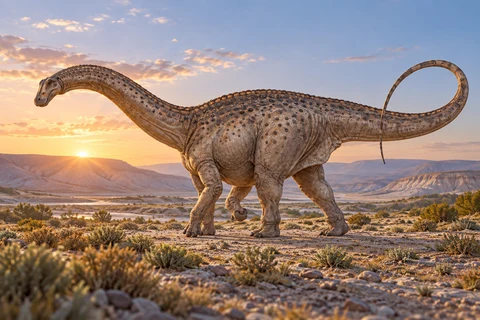
The illustration follows a complete reference explicitly identified as Dasosaurus tocantinensis. Its small head, long raised neck, substantial body and tapering tail provide the visual framework. We do not substitute a Garumbatitan image simply because the animals were compared in a scientific analysis.
The neck elevation, exact soft-tissue proportions, colours and landscape remain artistic interpretations. A convincing whole animal does not establish its habitual feeding height, exact mass or the route followed by its ancestors.
Compare Brachiosaurus and Chubutisaurus, then browse the D directory.
Quick answers
- Where did Dasosaurus live?
- It is known from Early Cretaceous deposits in northeastern Brazil.
- Was it a titanosaur?
- The original study placed it among somphospondylans outside Titanosauria.
- Why compare it with a Spanish dinosaur?
- Shared anatomical characters supported a relationship with Garumbatitan in the study’s family-tree analysis.
- Does that prove an individual crossed the Atlantic?
- No. Evolutionary relationships concern ancient lineages and changing geography, not a documented journey by one animal.