Jurassic Dinos editorial · Updated · Source-based review
What was Condorraptor?
Condorraptor was a meat-eating theropod from Patagonia in Argentina. Its species is Condorraptor currumili, described by Oliver Rauhut in 2005. The fossils come from the Cañadón Asfalto Formation near Cerro Cóndor in Chubut.
The animal contributes to our knowledge of Jurassic predatory dinosaurs in the Southern Hemisphere. This account uses the broad period because the formation’s narrower age has been interpreted differently in historical and later descriptions. The original paper used a Middle Jurassic assignment, whereas later museum terminology uses Early Jurassic.
Why choose one shin bone as the type?
The holotype is an incomplete left tibia, numbered MPEF-PV 1672. A tibia is one of the bones of the lower leg. Its anatomical features provided the stable reference needed to anchor the name.
Other remains from the locality include parts of the backbone, pelvis and hindlimbs, together with teeth. The original study regarded these as probably belonging to the same individual. Nevertheless, it treated them as referred specimens rather than making every associated fragment part of the name-bearing type.
Why keep that distinction?
Bones can become separated before burial and moved again afterward. The original geological description interpreted the deposit as involving redeposition in a gravity flow. The remains were fragmented, so their association had to be evaluated rather than taken for granted.
Keeping a single diagnostic type helps protect the name if later work finds that one referred element belongs to another animal. It is a practical example of scientific caution: a likely association can be useful without being written as an absolute certainty.
What does it reveal about theropods?
Researchers compared its anatomical characters with other early tetanuran theropods. Tetanurae is a large evolutionary branch containing many familiar predators. Detailed features of vertebrae and leg bones can contribute to a relationship hypothesis even when a complete skull is missing.
That does not mean every missing part can be reconstructed with equal confidence. Nor does an evolutionary comparison establish an exact speed, hunting strategy or social behaviour. Those questions need their own evidence.
Reading our complete image
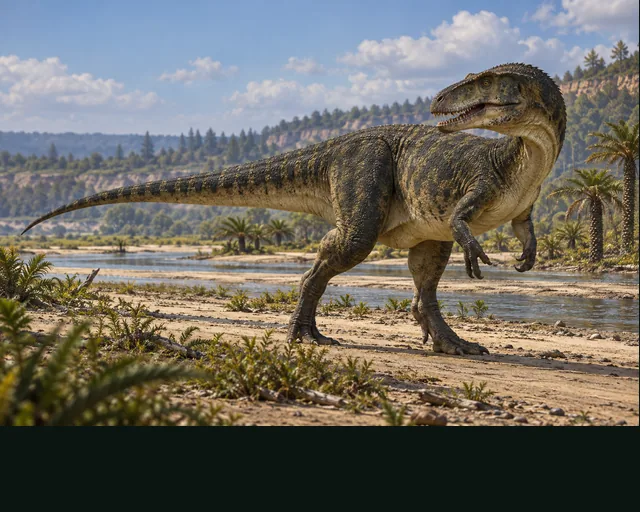
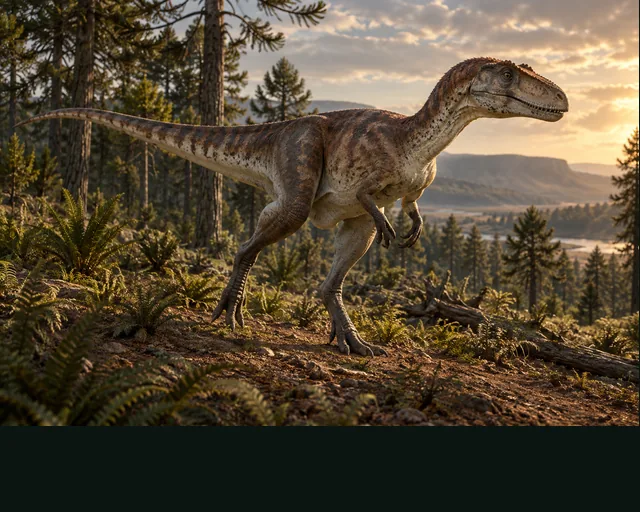
The portrait follows a full-body restoration specifically identified as Condorraptor currumili. Its upright pose, short forelimbs and high-curled tail come from that named artistic reference, rather than from asking a generator to interpret skeletal fragments.
The mane-like covering, tail tuft, colours and soft tissues remain artistic. They are not presented as preserved Condorraptor feathers or proof of its habitual stance. Separating those choices from the type specimen lets the picture remain engaging while the scientific record stays clear.
Compare Piatnitzkysaurus and Megalosaurus, then explore the C directory.
Quick answers
- Where was Condorraptor found?
- In the Cañadón Asfalto Formation of Chubut, Patagonia.
- What is its type specimen?
- An incomplete left tibia, or shin bone, numbered MPEF-PV 1672.
- Do all associated bones certainly belong to one individual?
- The original study considered that probable but kept them as referred material.
- Are the mane and tail tuft known fossils?
- No. They belong to the complete artistic reference used for this reconstruction.