Jurassic Dinos editorial · Updated · Source-based review
What was Citipes?
Citipes was a small caenagnathid theropod from Late Cretaceous Canada. Its species is Citipes elegans. The fossils come from Alberta’s Dinosaur Park Formation, a rock unit famous for preserving many kinds of dinosaurs.
Caenagnathids belonged to the oviraptorosaur branch of theropods. A feathered, beaked restoration may look very birdlike, but appearance alone cannot tell us the exact food, display behaviour or evolutionary position of an individual animal.
Could a small fossil just be a youngster?
This is a real problem for palaeontologists. A small bone might belong to a small adult species or to a growing member of a larger species. Sorting animals by size alone can therefore create too many names or hide real diversity.
The 2020 review investigated both anatomy and osteohistology. Osteohistology means studying the microscopic structure of bone. Growth-related tissue can supply information that the outer shape alone does not reveal. It gives researchers another way to test whether differently sized fossils represent different mature animals.
What did the review conclude?
The analysis supported three named caenagnathid taxa in the formation: smaller Citipes, intermediate Chirostenotes and larger Caenagnathus. That conclusion combined evidence rather than simply giving every size class its own name.
The study also highlighted a limitation. Assigning isolated bones to a species is difficult when specimens do not preserve overlapping parts of the skeleton. A hand and a foot cannot be directly compared in the same way as two examples of the same bone. Careful assignments keep the uncertainty visible.
Did different sizes mean different diets?
Differences in adult body size and jaw or foot anatomy may have reduced overlap between these animals’ ecological roles. However, the study did not turn their entire lives into a known menu. A suggestion about how related animals coexisted is different from identifying every meal.
For that reason, this account does not give Citipes a definite plant-only or meat-only diet. Its beak is interesting evidence to investigate, not permission to invent a favourite food.
Reading the feathered picture
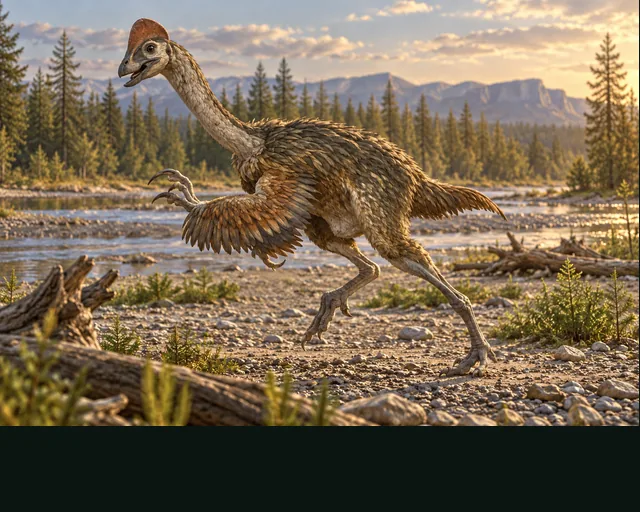
Our image follows a complete restoration explicitly labelled Citipes elegans. It retains the beaked head, winglike forelimbs, long hindlimbs and broad feathered tail. The blue pattern, head ornament and display pose belong to the reference artist’s interpretation. They do not demonstrate preserved Citipes colours or identify the animal as male. The picture invites comparison while the source notes explain the evidence behind the name.
Compare Chirostenotes and Oviraptor, then browse the C directory.
Quick answers
- Where was Citipes found?
- Its fossils come from the Dinosaur Park Formation of Alberta, Canada.
- Was it just a young Chirostenotes?
- The reviewed study used bone microstructure as well as anatomy to support a distinct smaller adult taxon.
- What did it eat?
- Its exact diet is not established here; a beak alone does not identify every food it ate.
- Do blue feathers identify a male?
- No. The colour and display in the approved artistic reference are speculative.