Jurassic Dinos editorial · Updated · Source-based review
What was Chenanisaurus?
Chenanisaurus was a meat-eating dinosaur from Morocco. Its species is Chenanisaurus barbaricus. Researchers identified it as an abelisaurid, a member of a predatory dinosaur group that also includes animals with deep heads and strongly reduced forelimbs.
Its fossils belong to the latest part of the Cretaceous. They provide a rare glimpse of African land animals near the end of non-avian dinosaur history. Calling it one of the dinosaurs from that interval is more accurate than claiming that scientists have found the very last individual dinosaur in Africa.
How much of the animal was found?
The discovery centred on a jaw fragment from the Sidi Chennane phosphate mines in the Oulad Abdoun Basin. A jaw can preserve important identifying features, including the shape of its bones and the arrangement of tooth-bearing structures. It does not preserve the entire animal’s body outline.
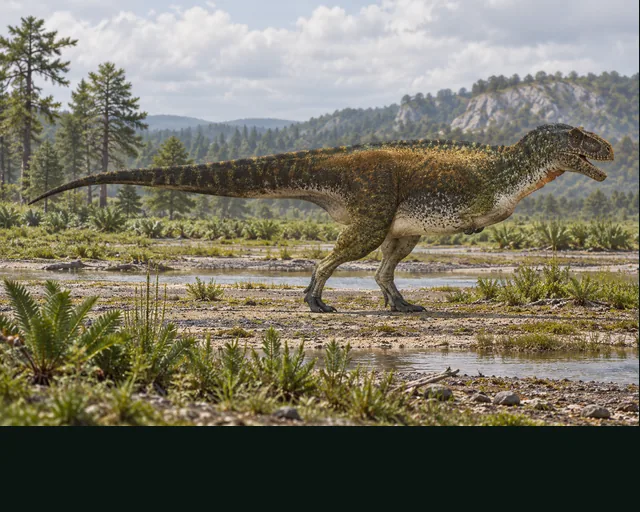
The University of Bath announcement describes the fossil and its interpretation as a new abelisaurid. Our complete image is therefore clearly labelled as an artistic restoration. Tiny forelimbs and the finished body follow an approved, specifically identified full-body reference; they are not presented as a complete Chenanisaurus skeleton discovered in the mine.
Why was a land dinosaur in marine rocks?
Morocco’s phosphate deposits contain abundant marine fossils. Finding a terrestrial animal among them may seem surprising, but the place where remains are buried is not always the place where the animal normally lived.
A carcass or detached bone can be carried away from land before burial. Establishing the exact journey of a particular fossil is difficult, so we do not invent a specific flood or storm. The essential lesson is that marine burial alone does not turn Chenanisaurus into a swimming predator.
Did later discoveries complete its skeleton?
A 2023 research announcement described additional, smaller Moroccan abelisaurid remains. These were discussed as other animals, rather than missing pieces of the Chenanisaurus jaw specimen. Combining every nearby dinosaur fossil into one skeleton would erase the evidence for diversity.
The small sample also limits behavioural claims. Teeth and jaw anatomy can support a meat-eating interpretation, but they do not provide a film of a hunt, a known social group or a measured running speed. Likewise, skin colours and the image’s rough surface are artistic decisions. Recognising what is absent makes the surviving fossil more informative, not less impressive.
Compare Carnotaurus and Arcovenator, then browse the C directory.
Quick answers
- What fossil supports Chenanisaurus?
- It was identified from a jaw fragment, not a complete skeleton.
- Where was it found?
- In the Sidi Chennane phosphate mines of Morocco’s Oulad Abdoun Basin.
- Was it a swimming dinosaur?
- Marine burial does not establish an aquatic lifestyle; land-animal remains can be transported into the sea.
- Are the whole body and colours confirmed?
- No. The complete reference and generated image are artistic restorations of a poorly known animal.