Jurassic Dinos editorial · Updated · Source-based review
What was Changyuraptor?
Changyuraptor was a feathered dromaeosaurid from Early Cretaceous China. Long feathers on both the arms and legs give it the informal description “four-winged dinosaur”. That wording refers to feather surfaces, not to four separate pairs of limbs.
What makes the fossil distinctive?
The fossil preserves a feathered body and especially long tail feathers. These are direct evidence for plumage, unlike reconstructions of dinosaurs known only from bones. The preserved arrangement can be used to investigate how the animal moved through air.
Where was it found and how was it named?
Changyuraptor was named in 2014 from Liaoning Province. Researchers interpreted the known individual as an adult, making it an important comparison with smaller microraptorines. Bone maturity helps distinguish a small species from an immature member of a larger one.
What can we infer, and what remains uncertain?
Aerodynamic studies have discussed a role for the tail in controlling descent and landing. These are functional hypotheses tested with anatomy and models; a fossil does not preserve a recording of flight. Gliding, flapping and landing control are also different questions. Comparing Changyuraptor with Microraptor helps show that early feathered dinosaurs experimented with a wider variety of body arrangements than modern birds display.
Did it have four arms?
No. It had two arms and two legs, with long feathers forming aerodynamic surfaces on both pairs of limbs.
How can you check the evidence?
The Paleobiology Database record catalogues Changyuraptor under Microraptorinae. Its linked bibliography identifies this research starting point: G. Han, L. M. Chiappe, and S. -A. Ji, M. Habib, A. H. Turner, A. Chinsamy, L. Han. 2014. A new raptorial dinosaur with exceptionally long feathering provides insights into dromaeosaurid flight performance. Nature Communications 5(4382):1-9. Open the bibliographic record. A catalogue entry establishes the source trail; it does not independently verify every later illustration or behavioural claim.
Use the dated genus overview to follow the references behind the discovery and anatomy discussed above. When sources disagree, compare which specimen and rock layer each author studied. A reconstructed whole animal can combine original bones with comparisons to relatives; those two kinds of evidence should not be confused. The account above explains the particular limits that matter for Changyuraptor, rather than supplying unsupported size, speed or lifespan figures.
Read the image and keep exploring
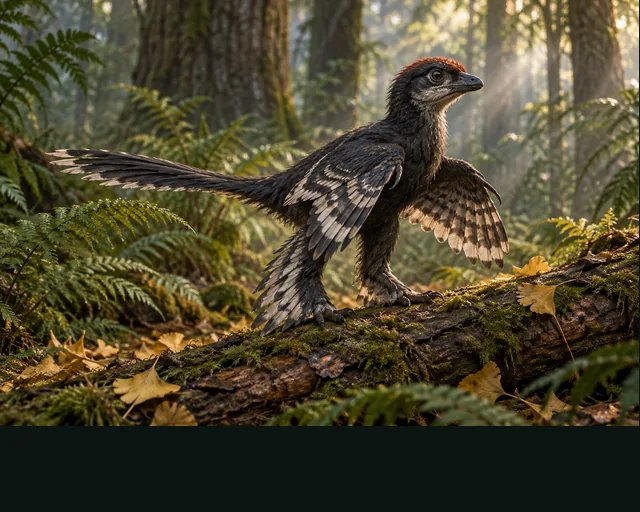
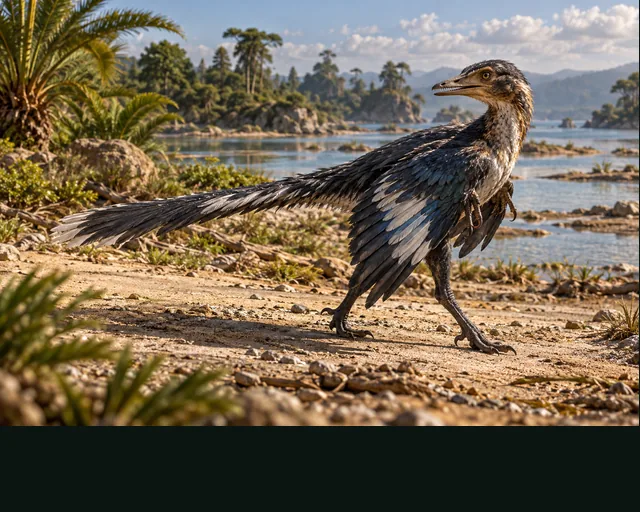
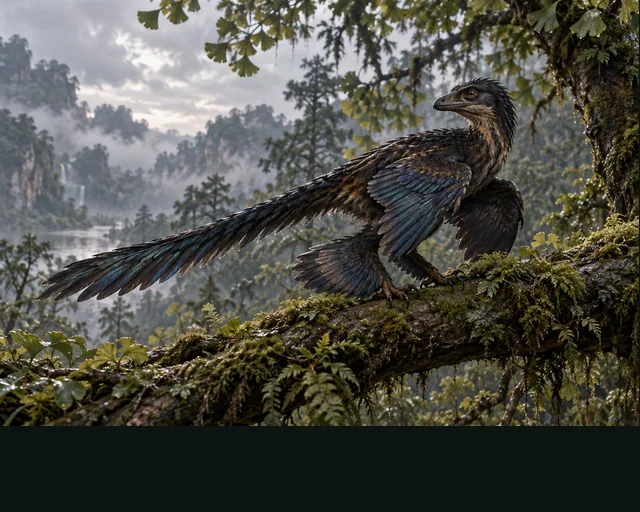
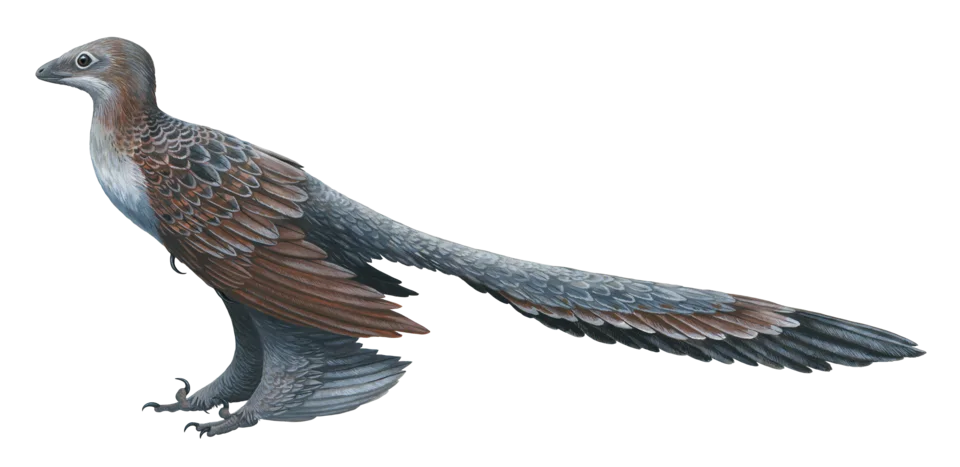
A feathered Changyuraptor restoration shows long tail and hindlimb feathers; its colours and exact soft-tissue outline remain interpretive. This is an artistic reconstruction: colours, soft tissues and missing anatomy include interpretation, not a photograph of a living dinosaur.
Compare Microraptor, Anchiornis, Archaeopteryx. Find more names in the C index and explore theropod field notes. The glossary explains unfamiliar fossil terms.
Quick answers
- Where have Changyuraptor fossils been found?
- The discoveries discussed here come from China. Modern place names describe discovery locations, not a complete ancient geographic range.
- When did Changyuraptor live?
- It is placed in the Cretaceous period. See the discovery discussion for qualifications about the particular rock layers and dating.
- Where can I compare Changyuraptor with related dinosaurs?
- Follow the related field notes below. Comparisons explain shared anatomy; they do not imply that all the animals lived together.