Jurassic Dinos editorial · Updated · Source-based review
What was Changchunsaurus?
Changchunsaurus was a small plant-eating dinosaur from northeastern China. Its species is Changchunsaurus parvus. Instead of the enormous body of a sauropod or the heavy head of a horned dinosaur, its reconstruction shows a compact animal with a long tail and hindlimbs suited to supporting a two-legged stance.
The fossils come from the Quantou Formation in Jilin. Their geological setting belongs to the Cretaceous, but published age descriptions have not always used the same narrower interval. This account therefore avoids attaching a deceptively exact birthday to the animal.
Why is its skeleton useful?
Some dinosaurs are named from only a small portion of the body. Changchunsaurus is especially useful because its type specimen includes both skull and substantial body material. The type is the specimen that anchors the scientific name; it is not necessarily an example of every age or variation in the species.
The 2011 study provided a detailed description of the postcranial skeleton. Postcranial simply means the parts behind the skull. A pelvis, limb joint or vertebra can carry evidence about relationships just as a tooth can. Scientists need the complete combination rather than a single eye-catching feature.
Was it the same as Jeholosaurus?
The study compared Changchunsaurus with another small Chinese dinosaur, Jeholosaurus. Its analysis found a close connection, while also identifying differences that supported keeping the two genera separate. Close relatives are not automatically two names for one animal.
An evolutionary analysis groups animals using anatomical characters. The result is a scientific hypothesis that can change when a new specimen supplies previously missing information. Early branches of the plant-eating dinosaur family tree are particularly interesting because several animals share a broadly similar small-bodied outline.
What can the picture tell us?
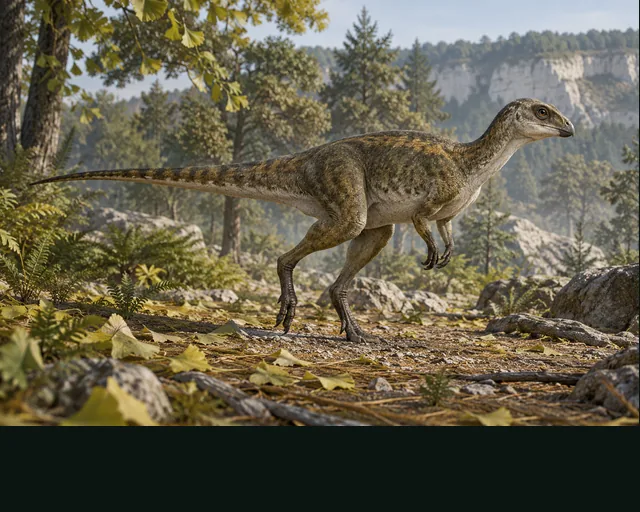
Our image follows a complete restoration specifically identified as Changchunsaurus. It supplies an accessible view of the whole animal without asking a reader to reconstruct a body from isolated bones. Nevertheless, a completed picture contains more detail than the fossil record directly establishes.
The colours, covering and landscape are artistic decisions. The bristly appearance is not presented as bristles discovered on this particular dinosaur. The illustration also cannot establish its running speed, group behaviour or daily routine. Keeping those limits visible makes the picture a starting point for questions rather than a substitute for evidence.
Compare Hypsilophodon and Iguanodon, then explore the C directory.
Quick answers
- Where was Changchunsaurus found?
- Its fossils come from the Quantou Formation of Jilin in northeastern China.
- Was it a large long-necked dinosaur?
- No. It was a small plant-eating dinosaur with a very different body plan from sauropods.
- Why study bones behind the skull?
- The limbs, backbone and other body bones supply anatomical characters that can be compared with related dinosaurs.
- Are the bristles in the picture preserved evidence?
- No. They follow the approved complete restoration and remain an artistic interpretation.