Jurassic Dinos editorial · Updated · Source-based review
What was Caletodraco?
Caletodraco was an abelisaurid theropod from Late Cretaceous France. Abelisaurids were meat-eating dinosaurs, a group that also includes Carnotaurus. Its species, Caletodraco cottardi, was described in 2024. Its discovery is striking because the fossils came from chalk deposited in an ancient sea, rather than the sort of inland rock many people associate with dinosaur hunting.
Where was it discovered?
The described remains came from lower Cenomanian chalk at Saint-Jouin-Bruneval in Normandy. Cenomanian is a subdivision near the beginning of the Late Cretaceous. A geological stage tells us the interval represented by the rocks, while a location tells us where they are exposed today.
The fossil’s burial setting is not necessarily the animal’s everyday habitat. Remains of a land animal can enter water and be carried away before burial. Marine sediment alone therefore does not demonstrate that Caletodraco was an underwater hunter or had special swimming adaptations.
Which parts were preserved?
The original account describes an associated hip-region group: the sacrum, both ilia and the first tail vertebra. The sacrum is the part of the backbone connected to the pelvis; the ilia are paired pelvic bones. An isolated tooth was found close to the bones.
These are useful identification clues, but they are not a complete skull or a pair of preserved tiny arms. Being found nearby also needs to be distinguished from being joined naturally to the skeleton. Careful wording prevents a more complete discovery from appearing in the reader’s imagination than the fossils actually support.
Why did the find interest researchers?
The authors used sacral and pelvic features to identify a distinct abelisaurid. A feature of the first tail vertebra contributed to placing it among furileusaurs, a branch then recognised mainly from South America. They interpreted the find as evidence for a more complicated European history of this group.
An evolutionary connection is not proof that two named animals met or that one crossed a particular sea. Biogeography asks how fossil distributions can be explained across changing continents and times.
What is artistic in the reconstruction?
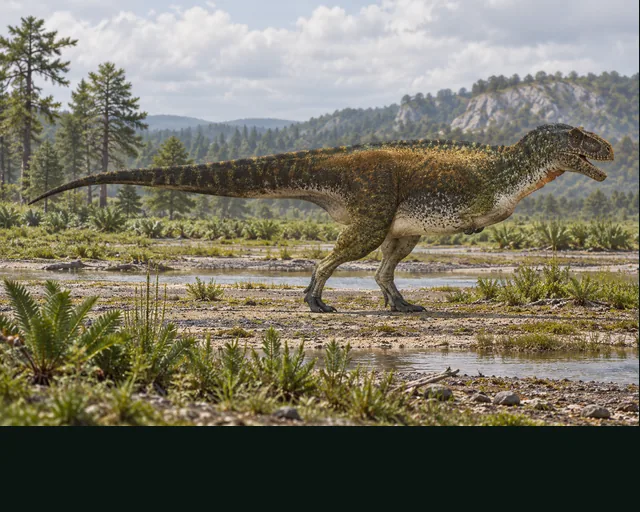
The complete, target-named reference supplies the deep short face, very reduced forelimbs, strong hindlegs and long tail used in our picture. Exact skull ornament, limb completion, skin colours and the landscape remain interpretations. We show the animal on land without treating its chalk burial as a swimming scene.
Compare Carnotaurus and Arcovenator, or browse the C directory.
Quick answers
- Where was Caletodraco found?
- In lower Cenomanian chalk at Saint-Jouin-Bruneval, Normandy, France.
- Does marine chalk mean it lived underwater?
- No. The sediment records the burial setting; a land animal’s remains can be transported into marine deposits.
- Was a complete skull discovered?
- No. The reviewed account centres on hip-region and tail material, plus a nearby tooth.
- Was it related to Carnotaurus?
- Both are abelisaurids. The original analysis placed Caletodraco in the furileusaurian branch, but this is not a claim of direct ancestry.