Jurassic Dinos editorial · Updated · Source-based review
What was Brasilotitan?
Brasilotitan was a plant-eating sauropod from Brazil. Its species is Brasilotitan nemophagus, described by Elaine Machado and colleagues in 2013. A distinctive part of its lower jaw makes this dinosaur especially interesting: it helps show that titanosaurs differed in more than just body size.
Titanosaurs were one branch of the long-necked sauropod dinosaurs. Recognising that broad group does not tell us every detail of an individual genus. In Brasilotitan’s case, the original researchers explicitly noted that its precise evolutionary position was difficult to establish.
Where were the fossils discovered?
The described material was collected near Presidente Prudente in São Paulo State. The original paper reported the Adamantina Formation and a Turonian–Santonian age, within the Late Cretaceous. Some short overviews use different age or formation assignments, so an exact numerical age is not supplied here.
Geologists can revise the boundaries and ages of rock units. A town, a formation and a geological stage are three different kinds of location information; matching them accurately is part of understanding a fossil, rather than a detail to skip.
What is special about the lower jaw?
The original description highlights an L-shaped arrangement and a slight inward twist around the dentary symphysis. The dentary is a main bone of the lower jaw, and the symphysis is the region where the two sides meet at the front.
Small changes in a jaw’s shape can be valuable when identifying a dinosaur. They may be less obvious in a landscape illustration than a giant horn, but they provide concrete anatomical features that scientists can compare.
Was an entire animal found?
The reported specimen includes lower-jaw material, neck and sacral vertebrae, a claw bone and parts of the pelvis. This is a collection of important clues, not a complete skull or whole body. We do not convert the illustrated silhouette into a measured length or weight.
Its sauropod identity supports a plant-eating interpretation. That broad diet does not reveal the exact leaves it preferred or the amount it ate each day. Those are separate questions requiring evidence beyond the material reviewed here.
How does the artwork handle the gaps?
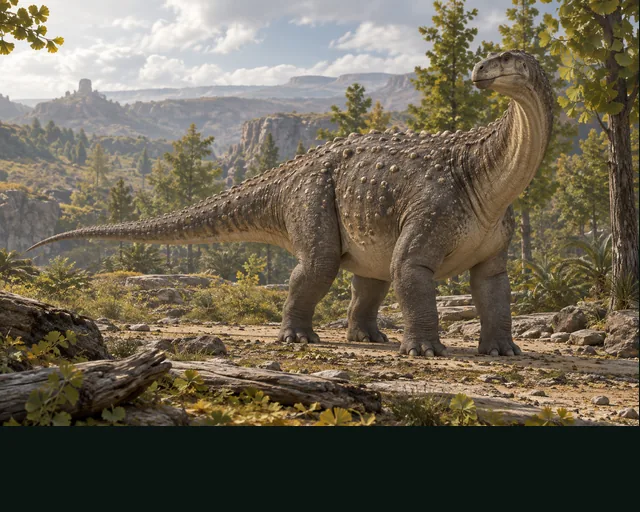
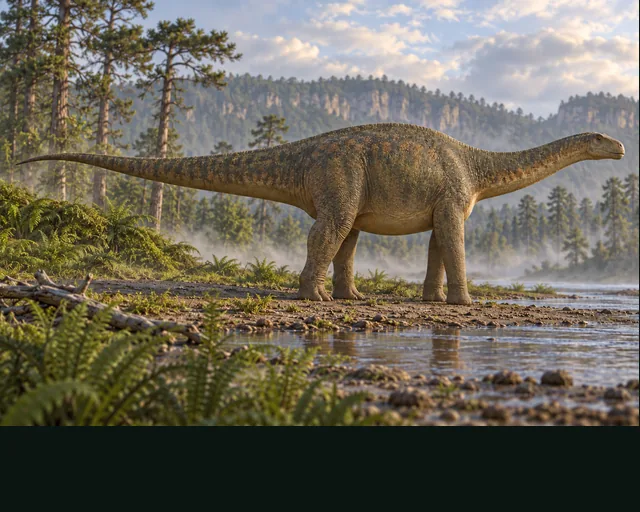
Our image follows a complete, explicitly named Brasilotitan restoration: a small blunt head, rising neck, weight-bearing legs and long tail. The scutes, colours and completed proportions remain artistic choices, not newly established features of the fossils.
Explore Bonitasaura and Saltasaurus, or browse the B directory.
Quick answers
- Where was Brasilotitan found?
- The original account describes material collected near Presidente Prudente in São Paulo State, Brazil.
- What is unusual about its jaw?
- The lower jaw had an L-shaped arrangement with a slightly inward-twisted joining region.
- Was a complete head found?
- The described head material includes part of the lower jaw, not a complete living head.
- What did it eat?
- It is interpreted as a plant-eating sauropod, but the reviewed evidence does not identify a favourite plant.