Jurassic Dinos editorial · Updated · Source-based review
What was Boreonykus?
Boreonykus was a meat-eating dromaeosaurid dinosaur from Late Cretaceous Canada. Dromaeosaurids are the animals often nicknamed raptors, although that informal word is also used for living birds of prey. The species is Boreonykus certekorum, and its name recalls a northern claw and the supporters recognised by the researchers.
Where were its fossils found?
Phil Bell and Philip Currie described material from the Pipestone Creek bonebed in Alberta’s Wapiti Formation. The study appeared online in 2015 and in a 2016 journal volume, which explains why both years appear in references.
A bonebed is a concentration of fossil bones. At Pipestone Creek, remains of the horned dinosaur Pachyrhinosaurus dominate, but they are not the only fossils. A less common animal can leave a handful of important clues inside a much larger collection.
Which clues identify this raptor?
The name-bearing specimen is a frontal, a bone from the roof of the skull. The museum account also lists claws, a tail vertebra and teeth recovered during excavations. Those pieces should not be described as a complete, connected raptor skeleton.
The original analysis placed Boreonykus among advanced dromaeosaurids and suggested a possible velociraptorine relationship. Possible is an important word: an evolutionary tree is a tested interpretation of characteristics, not a photograph of ancestry.
Why does the inland sea matter?
The deposits record land near a time when the Bearpaw Sea spread across much of North America’s interior. This makes northern terrestrial fossils useful for studying animals during an interval with fewer comparable land records elsewhere.
Finding raptor teeth among horned-dinosaur bones can support questions about feeding or scavenging. It cannot by itself show us a coordinated pack hunt. Teeth may be shed, remains may arrive at different times, and the events leading to burial require their own evidence.
How certain is the feathered appearance?
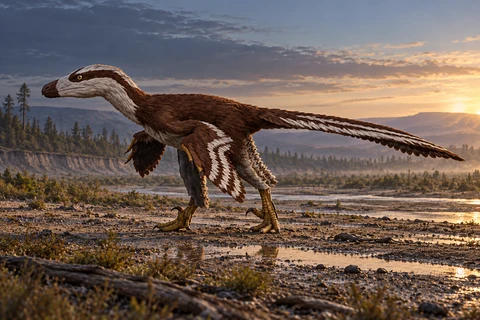
Our artwork follows an inspected, complete and explicitly named Boreonykus restoration. Its narrow head, feathered forelimbs, long hindlegs and broad feathered tail are retained as that artist’s living interpretation. The exact plumage and colours are not claimed as directly preserved for this genus.
The image shows one animal standing on land, without inventing a hunting scene. Compare Velociraptor and Acheroraptor, then explore more B names.
Quick answers
- Was Boreonykus a raptor?
- It was a dromaeosaurid, the dinosaur group informally called raptors.
- Where was it discovered?
- The described material came from the Pipestone Creek bonebed in Alberta’s Wapiti Formation.
- Did it definitely hunt Pachyrhinosaurus in packs?
- No. Their remains occur in the same bonebed, but that does not establish a coordinated hunting strategy.
- Are its full feathers preserved?
- The complete plumage in our image follows the credited artistic restoration; it is not a preserved Boreonykus feather coat.