Jurassic Dinos editorial · Updated · Source-based review
What was the Bisti Beast?
Bistahieversor was a meat-eating theropod dinosaur from New Mexico during the Late Cretaceous. Its best-known feature is a deep snout, making it an interesting member of the wider tyrannosauroid family tree. The scientific name is Bistahieversor sealeyi. Although its face may remind you of Tyrannosaurus, a resemblance is not a reason to give two animals the same name.
Where does its story begin?
Thomas Carr and Thomas Williamson formally described the animal in 2010. Their study identifies the adult type specimen from the Hunter Wash Member of the Kirtland Formation. A type specimen is the fossil reference to which a scientific name is attached, rather like a permanent reference copy in a library.
The authors also discussed other specimens. Their juvenile came from the Farmington Member of the Kirtland Formation, and additional material came from Fruitland rocks. These are separate fossil records, not pieces we can automatically combine into one individual. The species name honours Paul Sealey, who discovered the type specimen.
Why compare adults and young animals?
Growing animals can change shape. A young dinosaur’s skull therefore needs to be compared carefully with adult skulls before differences are used to propose another species. Imagine trying to identify a modern animal using only a young individual: size alone would be a poor guide.
For Bistahieversor, the original study used distinctive anatomical combinations to reassess fossils that had previously received other identifications. Scientific names can change when a better comparison becomes possible; this is a revision of evidence, not a change in what lived in the past.
What can the picture tell us?
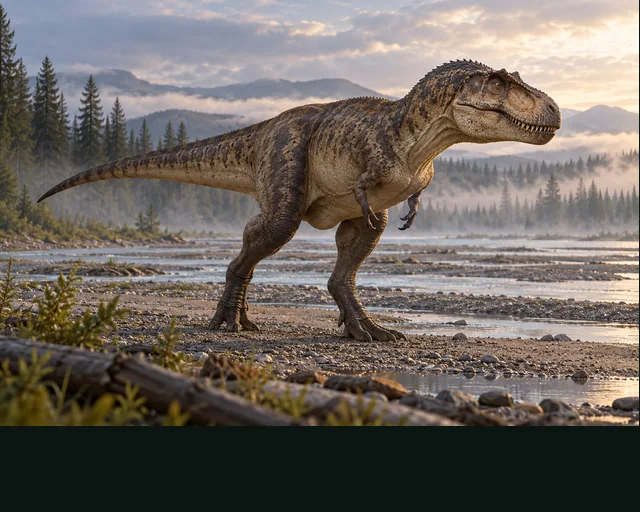
The illustration follows Petrodactylus’s explicitly named, complete Bistahieversor restoration. Look for the deep head, very small forelimbs, powerful hindlegs and long balancing tail. Sparse feathering along the back belongs to that artistic interpretation. It does not mean that this image documents fossilised feathers from this animal.
Colour, the sunset and the exact walking pose are imaginative choices. A picture cannot measure its speed or tell us which individual animal it was about to hunt. Keeping those limits visible makes the reconstruction more useful as a learning tool.
Compare Tyrannosaurus and Gorgosaurus, then explore more dinosaur names beginning with B.
Quick answers
- Was Bistahieversor the same dinosaur as T. rex?
- No. Bistahieversor sealeyi is a separately named tyrannosauroid from older Late Cretaceous rocks in New Mexico.
- What does the name remember?
- The genus refers to the Bisti landscape, while sealeyi honours fossil discoverer Paul Sealey.
- Are all its fossils one skeleton?
- No. The original study distinguishes the adult type and several referred specimens, including a juvenile.
- Did it have the feathers in this picture?
- The sparse feathering follows the credited full-body artistic reference; it is not presented as preserved Bistahieversor feather evidence.