Jurassic Dinos editorial · Updated · Source-based review
Bicharracosaurus dionidei was a sauropod from Late Jurassic Patagonia, Argentina, named in 2026. Its description adds evidence from the southern hemisphere to a period often illustrated with northern sauropod discoveries. The animal also highlights how difficult early sauropod relationships can be to resolve.
What was preserved?
Reutter and colleagues described a partial vertebral column and a fragment of the ilium, a major pelvic bone. The fossils come from the Cañadón Calcáreo Formation, discussed in an Oxfordian–Kimmeridgian Late Jurassic context.
Anatomical and histological evidence suggested an adult individual. Histology studies tissue structure. Evidence of maturity is valuable, but it does not reveal an exact age in years or turn partial material into a measured complete animal.
Where does it fit?
The study’s overall evidence supports placement within Macronaria, a broad sauropod branch. Several analyses and anatomical characters suggest brachiosaurid affinities, but the authors also emphasise problems in resolving early macronarian evolution.
That qualification belongs in a youth-friendly account. Different datasets can recover different branching arrangements even when researchers control which taxa they compare. A familiar tall-necked silhouette cannot settle the question on its own.
We therefore do not convert suggested brachiosaurid affinity into a categorical claim that every feature matched Brachiosaurus. A broad supported placement and a more tentative narrow one can both be useful.
What about other vertebrae from the formation?
The paper compares the animal with isolated vertebrae and another named macronarian from the same formation. Similarity prompts a test of possible relationships or assignment; it is not automatic proof that all the material belongs to one species.
The incomplete isolated specimens can move between positions in analyses. Combining them without qualification could hide precisely the uncertainty the study discusses. This account keeps its whole-body measurements open and does not construct an enormous composite animal from every potentially similar bone.
The image beyond the fossils
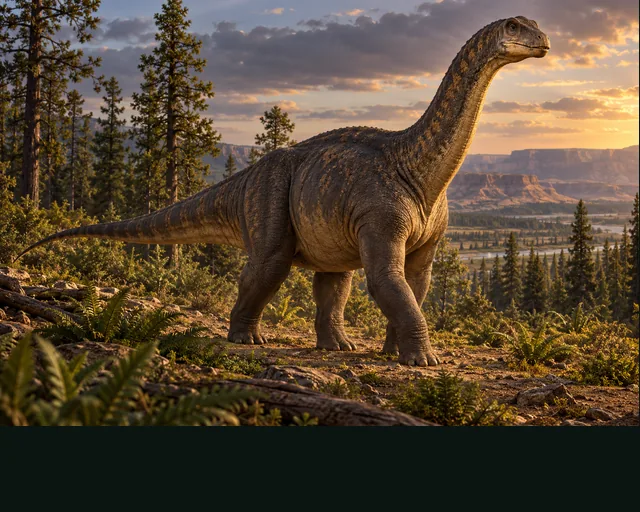
Connor Ashbridge’s complete named restoration supplies our visual reference: a small low head on a tall raised neck, broad torso, four long columnar limbs and a tapering tail. Posture, soft tissues, colours and the full outline remain artistic interpretations beyond the preserved vertebral and pelvic material.
Our independent cinematic scene follows that existing complete animal, not a skeleton, fossil photograph or another sauropod used as a substitute. Compare Brachiosaurus and Camarasaurus, then return to the A–Z directory. A new name can make the family-tree question richer without making every branch certain.
Quick answers
- What was Bicharracosaurus based on?
- A partial vertebral column and a fragment of the ilium, a pelvic bone.
- When and where did it live?
- In Late Jurassic Patagonia, represented by Argentina’s Cañadón Calcáreo Formation.
- Was it certainly a brachiosaurid?
- The 2026 study supports Macronaria overall, with several analyses suggesting brachiosaurid affinities; this is kept qualified.
- Does adult evidence give a precise age or size?
- No. Maturity evidence does not establish an exact age in years, total length or body mass.