Jurassic Dinos editorial · Updated · Source-based review
Berberosaurus liassicus was an Early Jurassic theropod from the High Atlas of Morocco. Its discovery helps investigate early theropod diversity, but its precise relationships have been interpreted differently. This account therefore separates the original proposal from later family-tree results.
What did researchers find?
Allain and colleagues described Berberosaurus in 2007 from associated, incomplete postcranial material in the Toundoute continental series. Postcranial means behind the skull. The described elements include vertebral, hand and hind-limb evidence.
Association helps researchers consider whether bones belong together. It does not mean that a whole skull, every limb element or the living body covering is preserved. A full restoration extends beyond the type material, even when it is clearly labelled with the correct animal name.
Why did the classification attract attention?
The original paper interpreted Berberosaurus as a basal abelisauroid. That placement had implications for how far back the group’s fossil record extended.
Carrano and Sampson’s 2008 discussion instead tentatively placed it outside Abelisauroidea as a basal ceratosaur. Different character assessments can therefore change both a relationship hypothesis and the historical record implied by it. The original paper’s title remains part of the literature, but it is not a reason to ignore subsequent work.
This page uses the broader theropod description and keeps the narrower affinities qualified. It does not advertise a permanent “oldest abelisauroid” record or identify Berberosaurus as the direct ancestor of a later dinosaur.
Does a relationship predict its missing head?
Not with certainty. A position near Ceratosaurus does not establish a nasal horn, and a comparison with another early theropod does not supply a measured skull. Reconstructing a missing animal region requires its own visual and scientific limits.
The broad carnivorous interpretation should likewise not be expanded into a documented prey list, hunting pack or precise running speed. Those are different questions from identifying anatomical relationships.
The complete named artwork
Mario Lanzas’s whole Berberosaurus restoration supplies the image reference: a long low snout, short grasping forelimbs, long hind legs and a balancing tapering tail. Its soft tissues, covering and colours remain interpretations. The accompanying human silhouette is omitted and is not used to calculate size.
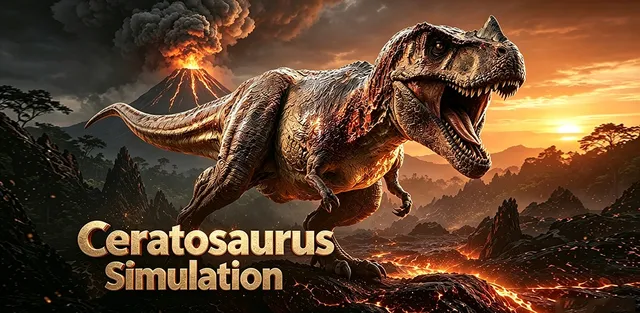
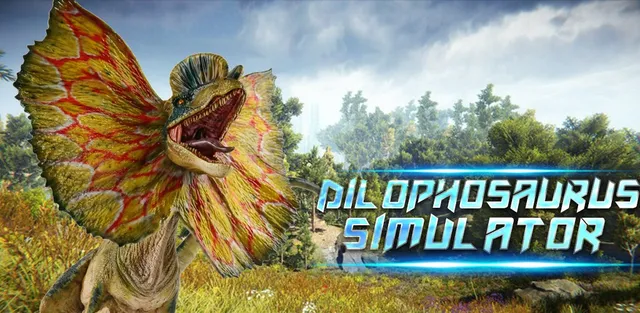
Our independent cinematic scene follows that existing complete animal rather than assembling a body from fossils or a relative. Compare Ceratosaurus and Dilophosaurus, then return to the A–Z directory to explore other early theropod stories.
Quick answers
- Where did Berberosaurus live?
- In the Early Jurassic of Morocco’s High Atlas, represented by the Toundoute continental series.
- Was it definitely an abelisauroid?
- That was the original interpretation; a later analysis tentatively placed it outside Abelisauroidea as a basal ceratosaur.
- Was a complete skeleton found?
- No. The named material is an incomplete associated postcranial specimen.
- Did it have Ceratosaurus’s horn?
- A relationship hypothesis does not supply a missing skull or horn. The image follows a complete named Berberosaurus restoration.