Jurassic Dinos editorial · Updated · Source-based review
Avisaurus was an enantiornithine bird from the Late Cretaceous of North America. Enantiornithines were an extinct bird branch. Being a bird does not put Avisaurus outside dinosaurs: birds belong within theropod dinosaurs. Its anatomy, however, deserves a bird account rather than a generic image of a small ground-running reptile.
Start with the species name
The complete visual reference used here specifically depicts Avisaurus archibaldi. A 2024 study by Clark and colleagues described additional avisaurid diversity, including Avisaurus darwini. The two species are not interchangeable.
This distinction matters whenever a discovery receives attention for size or behaviour. A result involving a newly named species should not automatically become a measurement or proven habit of every member of its genus. We focus the image on archibaldi and discuss the broader research with its species limits intact.
What can a foot reveal?
The 2024 study investigated the tarsometatarsus, a bird lower-limb element formed from ankle and metatarsal components. Its proportions and muscle-attachment features can be compared with those of living birds. Such comparisons help researchers test how a foot might have functioned.
The authors found features consistent with powerful constriction and raptorial use. Raptorial refers to grasping prey. This is a functional interpretation supported by anatomy, not a fossil recording a hawk-like attack in progress. It cannot supply a complete menu or identify the exact prey of the animal in our illustration.
Why keep uncertainty visible?
A strong hypothesis is more useful when readers know what supports it. Foot form can suggest abilities; a particular meal would require different evidence. Likewise, a named bird reconstructed with feathers is not evidence that its original colour or full wing outline is preserved.
We leave the precise diet field open rather than converting the predation hypothesis into a detailed food list. The broader bird identity is secure even though many details of life remain uncertain.
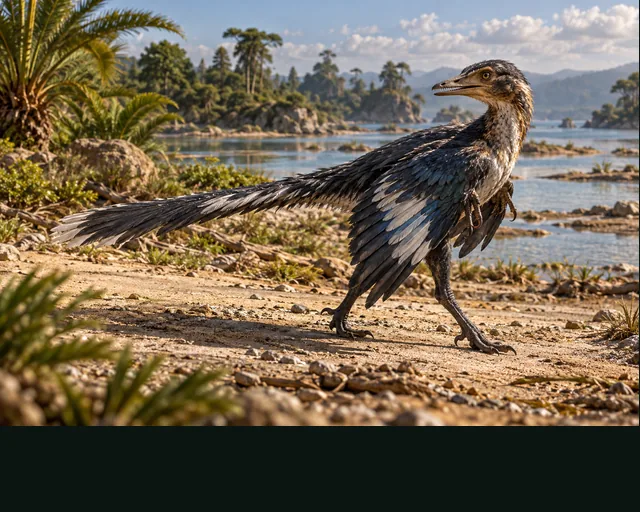
Our folded-wing restoration
Tomozsaurus’s complete named artwork shows the whole Avisaurus archibaldi bird with folded feathered wings, both feet and a short feathered tail. The larger crocodilian used as a perch in that artwork is not an anatomy reference and is omitted from our new scene. A neutral log provides a perch without claiming witnessed cooperation between species. The wings stay folded because the reference does not reveal a complete spread-wing shape.
Read Archaeopteryx and Velociraptor to explore different parts of the bird–theropod story, then browse the A–Z directory.
Quick answers
- Was Avisaurus a bird or dinosaur?
- It was an enantiornithine bird; birds belong within theropod dinosaurs.
- Which species does the reference show?
- The credited complete artwork explicitly identifies the bird as Avisaurus archibaldi.
- Is Avisaurus darwini the same species?
- No. The 2024 study names darwini separately; its details should not be pooled with archibaldi.
- Did it definitely hunt like a modern hawk?
- Foot morphology supports a raptorial hypothesis, but it does not document a particular hunting event or complete diet.