Jurassic Dinos editorial · Updated · Source-based review
Austrosaurus mckillopi was an Early Cretaceous sauropod from Queensland, Australia. Named by Longman in 1933, it occupies an important place in the history of Australian dinosaur research. Its story also shows why a historically important fossil can still benefit from a modern re-examination.
What did the reappraisal study?
Poropat and colleagues returned to the material in 2017. Their study concerns the Allaru Mudstone and reconstructs a series of six presacral vertebrae, including the last neck vertebra and the first five back vertebrae, with associated ribs.
Presacral simply means before the sacrum, the pelvic section of the spine. Explaining that word helps make the inventory useful: six vertebrae are not six complete animals, and a connected series is not a complete neck, trunk and tail. Historical referrals also need checking rather than assuming that every old bone bearing the same name belongs with the type.
Why did researchers use CT?
The reappraisal examined both the external form and internal anatomy visualized through CT data. CT scanning allows researchers to look through a specimen in a sequence of images. It can reveal internal spaces and structures without treating a broken surface as the only available window.
That information helps test whether the fossil contains distinguishing anatomical features. It does not supply a preserved skin pattern or recover missing body parts. Modern technology can improve an identification without magically making a fragmentary skeleton complete.
Where does Austrosaurus belong?
The 2017 study validates it as a diagnostic titanosauriform and tentatively places it in Somphospondyli. The word tentatively is part of the finding. This page follows that qualification rather than turning a simplified family label into a settled detailed relationship.
The Natural History Museum presents Austrosaurus as a herbivorous sauropod and gives a fifteen-metre length. That public-facing length is a reconstruction estimate, not a measurement of a complete type skeleton. We do not derive a precise mass or a maximum size from the artwork.
What our image represents
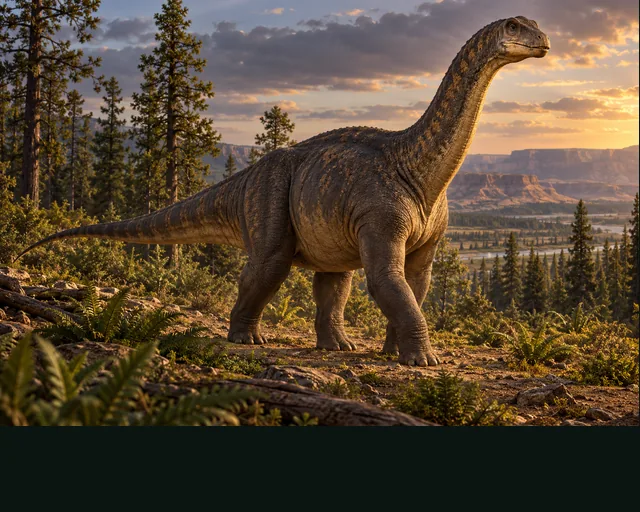
The Natural History Museum’s complete, named restoration provides the visual reference, showing a small elevated head, long neck, deep four-legged body and slender tail curled behind it. The historical restoration includes missing anatomy; posture, skin and colours remain interpretations. Our independently composed scene follows that whole animal rather than creating one from vertebral photographs.
Compare Brachiosaurus and Camarasaurus, then return to the A–Z directory. A careful reappraisal can be as revealing as a new excavation.
Quick answers
- Where did Austrosaurus come from?
- The Allaru Mudstone of Queensland, Australia.
- Was a whole skeleton found?
- No. The reappraisal reconstructs a series of six presacral vertebrae with associated ribs.
- How was it re-examined?
- Researchers studied external anatomy and CT views of internal structure.
- Is it securely a titanosaur?
- The 2017 study identifies a diagnostic titanosauriform and tentatively places it in Somphospondyli; this page avoids a narrower settled assignment.