Jurassic Dinos editorial · Updated · Source-based review
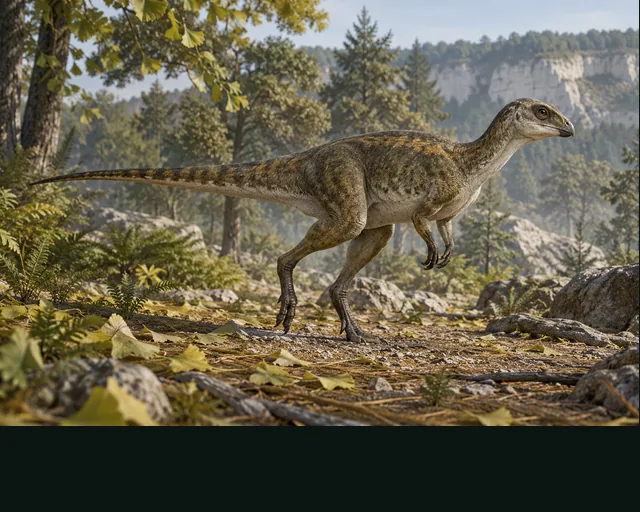
Atlascopcosaurus loadsi was a small plant-eating ornithopod from Early Cretaceous Australia. The Natural History Museum lists it among Australian dinosaurs, but its whole-body illustration should not be mistaken for a complete skeleton discovered in the ground.
Start with the upper jaw
The 2023 annotated checklist of Australian Mesozoic tetrapods identifies the type specimen, NMV P166409, as an isolated left maxilla. A maxilla is an upper jaw bone. Jaw shape and teeth can contain useful identifying features even when limbs and a tail are absent.
The same review identifies the type locality as Point Lewis on Cape Otway in Victoria, within the Eumeralla Formation. It correlates the relevant rocks with the early Albian, part of the Early Cretaceous. A formation is a geological unit, not an assertion that all animals found throughout it lived at exactly the same moment.
Is the name accepted?
The checklist retains Atlascopcosaurus loadsi while explaining that its validity has been questioned in previous research. Its exact relationships among ornithopods have also varied between analyses. That deserves a qualification, rather than either erasing the name or presenting a narrow family assignment as undisputed.
This account follows that retained treatment and makes the uncertainty visible. It does not claim a settled close relationship merely because another small plant eater looks similar. A fossil-based classification depends on compared anatomical characters, not on the colour or pose chosen by an illustrator.
How big was it?
The Natural History Museum gives a three-metre length in its public directory. That is an estimate for a reconstructed animal, not the length of a complete type skeleton. We do not convert it into a precise measured maximum or attach an unsupported mass.
The broader herbivorous interpretation is appropriate, but a particular favourite plant, speed or social habit would need more evidence. The preserved jaw cannot by itself answer every attractive question about the animal’s daily life.
Our visual reference
The complete named restoration from the Natural History Museum supplies the form for the new scene: a small head, slender neck, short forelimbs, long hind legs and a narrow curved tail. Colour and missing-body proportions remain interpretations. We use that whole restoration rather than generating a body from jaw photographs or borrowing an unnamed relative.
Compare Hypsilophodon and Dryosaurus, then explore the A–Z directory. A familiar small-dinosaur silhouette can accompany a fossil record that is much less complete than it looks.
Quick answers
- What was the type fossil?
- An isolated left maxilla, the upper jaw bone, catalogued as NMV P166409.
- Where was it found?
- The 2023 checklist identifies Point Lewis, Cape Otway, Victoria, in the Eumeralla Formation.
- Was its complete body discovered?
- No. The principal named material is jaw evidence; the whole-body image is a restoration.
- Is its exact relationship settled?
- No. The 2023 review retains the name but notes debate about validity and its position among ornithopods.