Jurassic Dinos editorial · Updated · Source-based review
Athenar bermani is a sauropod named in 2025 from Dinosaur National Monument in Utah, USA. The fossil behind the name is surprisingly small compared with a giant mounted skeleton: a braincase and part of the skull roof. Its importance comes from what it changes about an old identification.
A familiar specimen reconsidered
The specimen, CM 26552, is housed at Carnegie Museum of Natural History. It had helped underpin an influential description of Diplodocus braincase anatomy. Whitlock and colleagues returned to it after decades of new discoveries had made more detailed comparisons possible.
Their study concluded that the specimen differed from Diplodocus and from Diplodocidae, the wider family containing it. They instead interpreted it as a new dicraeosaurid, naming Athenar bermani. The geological setting is the Late Jurassic Morrison Formation.
This is a reminder that museum research is not confined to newly excavated bones. An existing specimen can answer a different question when researchers gain new comparisons or re-examine the features used in an earlier identification.
What is a braincase?
A braincase is the bony region surrounding the brain. It can preserve informative openings, contacts and internal spaces, but it is not the brain itself. Describing a braincase does not mean that soft brain tissue survived.
It also does not recover a complete animal’s behaviour. We cannot read intelligence, personality or daily habits directly from the new genus name. A careful account separates an anatomical identification from much more speculative claims about life.
Why does the family change matter?
Diplodocids and dicraeosaurids are different branches among diplodocoid sauropods. That broader similarity explains why comparison is useful, but it does not make their anatomy interchangeable. Athenar’s reassignment should not be used to transfer every measurement or neck feature associated with Diplodocus into a new facts table.
The study identifies a particular cranial specimen. It does not convert every fossil formerly called Diplodocus into Athenar, nor establish the exact total length of the animal represented by CM 26552.
Showing the animal responsibly
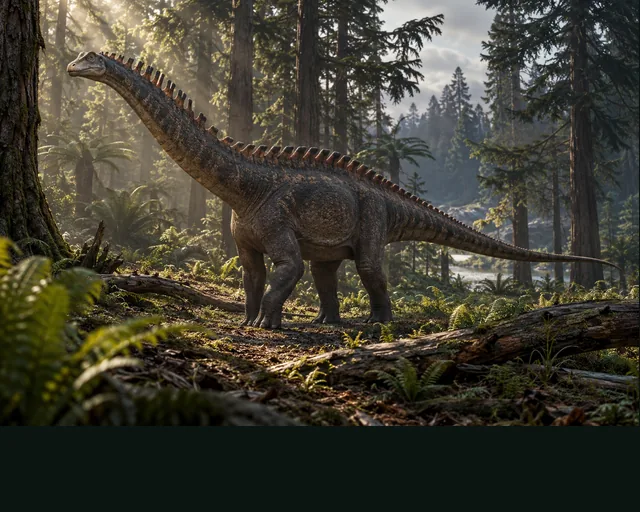
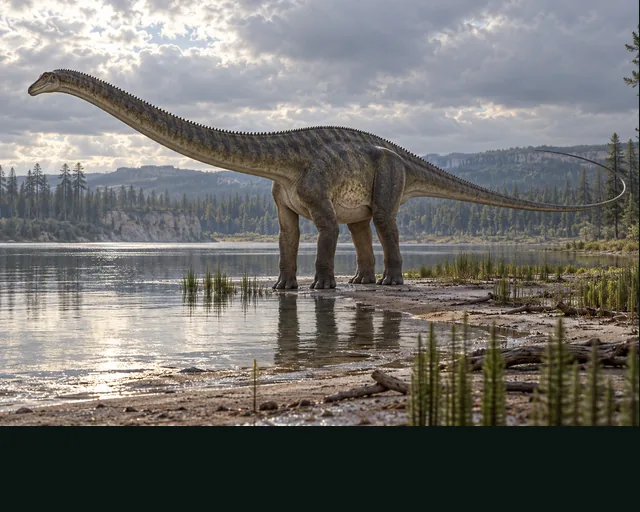
Connor Ashbridge’s complete restoration specifically labelled Athenar bermani is our whole-body visual reference. It depicts a small low head, a long low neck, four columnar limbs, a broad torso and a fine tapering tail. Our independent scene follows that artwork, with proportions, covering and colour acknowledged as interpretations beyond the preserved cranial material.
Read Diplodocus and Dicraeosaurus to compare the branches, then explore the A–Z directory. A revised identity can be scientifically important even without a newly discovered giant skeleton.
Quick answers
- What is Athenar based on?
- Specimen CM 26552, a braincase and partial skull roof from Dinosaur National Monument, Utah.
- Why was the fossil called Diplodocus before?
- It had been used in an influential description of Diplodocus braincase anatomy; later comparisons supported a different identity.
- Is Athenar a diplodocid?
- The 2025 study interprets it as a dicraeosaurid, outside Diplodocidae.
- Does the artwork show a complete discovered skeleton?
- No. Its whole-body form follows a named artist’s restoration; the type material is cranial.