Jurassic Dinos editorial · Updated · Source-based review
Astrophocaudia slaughteri was an Early Cretaceous sauropod from Texas. Its fossils belong to the Paluxy Formation within the Trinity Group. The animal’s story concerns an important scientific task: checking whether a collection labelled with a familiar dinosaur name really belongs there.
Sorting the Texas sauropods
Michael D’Emic’s revision, published online in 2012 and in a 2013 journal volume, examined sauropod remains that had been assigned to names such as Astrodon and Pleurocoelus. The study did not simply replace every old label with one new label. Different fossils had different anatomical evidence.
Some of the material supported the new genus Astrophocaudia. Other specimens were discussed separately in relation to Sauroposeidon, Paluxysaurus or Cedarosaurus. Keeping those decisions separate prevents an easy mistake: attaching another sauropod’s skeleton, growth assessment or body dimensions to Astrophocaudia just because both appear in the same paper.
Why focus on the tail?
The description identifies a hyposphene–hypantrum system in the tail vertebrae. These are additional interlocking joint structures between neighbouring vertebrae. Their presence is part of the diagnosis, the combination of features that lets researchers distinguish a taxon.
That anatomical observation is more secure than a dramatic guess about what the animal did with its tail. Extra joints do not by themselves establish a particular defensive behaviour or prove how much movement occurred during life. Identifying a structure and testing its mechanical function are related but different questions.
Where does it fit on the tree?
D’Emic placed Astrophocaudia among somphospondylan sauropods. Mannion and colleagues’ comparative research also recovered that broad affinity, while finding that exact branching relationships could vary between analyses. A family tree can therefore support a broad placement without securely naming one closest relative.
The group context supports a plant-eating sauropod interpretation. It does not document an individual menu or provide an independently verified total body mass. Those details are not filled in just to complete a facts table.
Reading our restoration
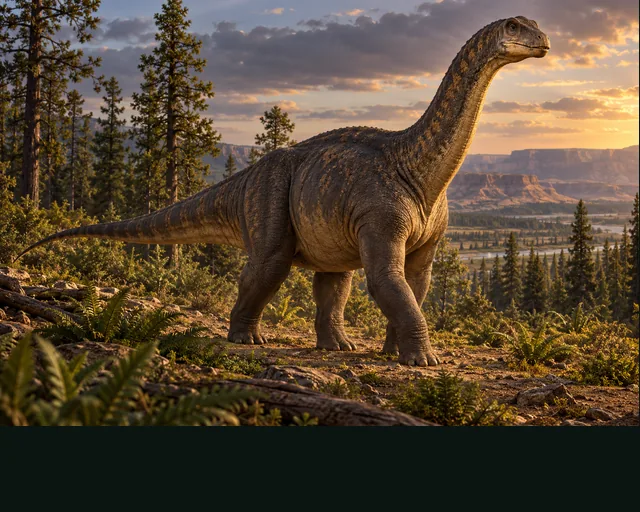
Levi B. Martinez-Reza’s complete, named artwork supplies the visual reference: a small blunt head, extremely long raised neck, broad trunk, four columnar legs and a tapering tail. Our scene follows that restoration, with posture, colour and soft tissues explicitly treated as interpretations. It is not a record of a complete recovered skeleton.
Compare Brachiosaurus and Camarasaurus for other sauropod body plans, then return to the A–Z directory. Similar silhouettes are an invitation to compare evidence, not permission to combine measurements.
Quick answers
- Where did Astrophocaudia live?
- In Early Cretaceous Texas; its fossils come from the Paluxy Formation of the Trinity Group.
- Why are the tail joints important?
- Their extra interlocking articulations form part of the anatomical diagnosis used to distinguish the genus.
- Is it just another name for Sauroposeidon?
- The original revision treats Astrophocaudia as distinct; its separate discussion of Paluxysaurus and Sauroposeidon must not be confused with it.
- Can the illustration give its exact length?
- No. A complete artistic restoration is not a measured complete fossil skeleton.